
Saving for a down payment feels like chasing a bus that never stops. Rent keeps climbing every year. Groceries cost more than they used to. Your savings account barely moves no matter how hard you try, and buying a house starts to feel like something other people get to do.
If this sounds like your life right now, you are far from alone. Thousands of Hoosiers hit this same wall every single year. The good news is that Indiana has built real help for people in your exact situation. This guide covers every first time home buyer programs indiana option available right now, from federal loans to state grants to local city help. By the end, you will know which program fits your income and credit, and exactly how to start. For extra help sorting through your options, you can also reach out to james@allthings-mortgage.com.
What is a first-time home buyer program?
A first-time home buyer program is financial help offered by the government or a housing agency. It exists to make buying a house easier for people who have never owned one before, or who have not owned one in a few years. Most first time home buyer programs indiana options fall into a few simple categories.
These programs usually offer one or more of the following:
- Lower down payment requirements
- Reduced interest rates on your loan
- Grants or forgivable loans for closing costs
- Tax credits that lower what you owe each year
Some of these programs come from the federal government. Others come directly from the state of Indiana. Many buyers stack two or three programs together to shrink their upfront costs even more.
None of these programs hand out free houses. They lower barriers, not eliminate them completely. You still need steady income, a reasonable credit history, and the ability to cover your monthly mortgage payment once you move in.
Think of these programs as tools rather than shortcuts. Each one solves a different problem, whether that is a thin down payment, a tight monthly budget, or a high tax bill. Picking the right combination for your situation matters more than trying to use every program at once.
Who qualifies as a first-time home buyer?
You might assume you need to be brand new to buying a home to qualify. That is not fully true. Most Indiana and federal programs define a first-time buyer as someone who has not owned a primary residence in the past three years.
This means past homeowners can often qualify again. Divorced buyers, people who sold a home years ago, and long-time renters who once owned property may all count. Each program sets its own income limits and purchase price caps, so checking the fine print before you apply saves time later.
Household size also plays a role in your eligibility. A single buyer and a family of five will often face different income ceilings, even in the same county. Your lender can pull the exact numbers for your area within minutes, so there is no need to guess on your own.
Federal programs for first-time home buyers in Indiana
Before diving into state-specific help, it helps to understand the federal loans open to nearly every Indiana buyer. These loans are backed by the U.S. government, which makes lenders far more willing to approve buyers with lower credit scores or smaller savings. Many of these federal options can also be paired with state-level down payment assistance for even lower upfront costs.
FHA loans
FHA loans are backed by the Federal Housing Administration. They remain one of the easiest loans to qualify for. Many lenders approve buyers with a credit score as low as 580 and a down payment of just 3.5%.
This loan works well when your credit history is short or your savings are thin. FHA loans do require mortgage insurance, which adds a small monthly cost on top of your payment. Still, for many first-time buyers, this is the most realistic place to start.
You will need standard paperwork to apply, including recent pay stubs, tax returns, and bank statements. Lenders also check your debt-to-income ratio, which compares your monthly bills to your monthly income. Keeping that ratio below 43% gives you the best shot at approval on an FHA loan.
USDA loans
USDA loans help buyers purchase homes in eligible rural and suburban parts of Indiana. Plenty of small towns and outer suburbs actually qualify, so do not assume this loan only applies to farmland.
The biggest draw is the 0% down payment requirement. Income limits do apply, and the home must sit inside an approved USDA zone. If your target location qualifies, this loan can save you thousands of dollars upfront.
You can check eligibility for a specific address through the USDA’s own property lookup tool before you fall in love with a listing. Many buyers are surprised to learn that towns just outside Indianapolis, Fort Wayne, and other cities still qualify. This makes the USDA loan worth checking even if you are not picturing farmland.
VA loans
VA loans are reserved for veterans, active-duty service members, and certain surviving spouses. They allow up to 100% financing, meaning no down payment at all.
There is also no private mortgage insurance required, which keeps your monthly payment lower. Closing costs still apply, but sellers can often agree to cover part of them. This loan remains one of the strongest benefits available to those who served.
Most VA borrowers pay a one-time funding fee instead of monthly mortgage insurance. This fee can be rolled into the loan amount, so it rarely requires cash out of pocket at closing. Veterans with a service-connected disability are often exempt from this fee entirely.
Conventional 97 Loan
The Conventional 97 loan lets qualified buyers put down just 3% of the purchase price. Unlike FHA loans, this program skips upfront mortgage insurance and only charges a monthly premium that can be removed later.
This option suits buyers with steady income and a credit score around 620 or higher. Once your home equity reaches 20%, you can ask your lender to drop the mortgage insurance completely.
This loan often appeals to buyers who have decent credit but want to avoid FHA’s upfront insurance charge. It works especially well when paired with IHCDA down payment help, since both programs allow gift funds from family members.
State programs for first-time home buyers in Indiana

Indiana also runs its own set of programs through a dedicated state housing agency. These state programs for first-time home buyers in Indiana can be paired with the federal loans above to lower your total costs even further. Understanding both layers together is the fastest way to build a full picture of first time home buyer programs indiana has to offer.
Indiana Housing and Community Development Authority (IHCDA) loans
The Indiana Housing and Community Development Authority, known as IHCDA, is the backbone of homebuyer help across all 92 counties. IHCDA partners with approved lenders to offer better rates and real down payment assistance to qualified buyers. Below are its main programs.
IHCDA does not lend money to you directly. It works behind the scenes with a network of approved banks and credit unions across the state. This structure means your day-to-day experience still feels like a normal mortgage application, just with extra benefits layered on top.
First Place Program
First Place gives qualifying first-time buyers up to 6% of the purchase price toward their down payment. On a $200,000 home, that adds up to $12,000 in real help.
The assistance arrives as a second mortgage with no interest and no monthly payment attached. If you stay in the home for the full term without selling or refinancing, the balance is forgiven completely.
To qualify, you must work with an approved lender, meet county income limits, and stay under the purchase price cap for your area. Most buyers pair First Place with an FHA first mortgage, since the two programs are built to work together.
Next Home Program
Next Home offers up to 3.5% in down payment assistance on FHA loans, or up to 3% on conventional loans. Unlike First Place, this program is open to both first-time and repeat buyers.
The assistance is forgiven after just two years of on-time payments and steady occupancy. This shorter forgiveness window makes it appealing to buyers who might need to move again within a few years.
Next Home tends to fit younger buyers or those in early-career jobs that could mean a move down the road. Because the forgiveness period is shorter than First Place, it carries slightly less long-term commitment, which some buyers find reassuring.
Mortgage Credit Certificate (MCC)
The MCC turns part of your mortgage interest into a direct federal tax credit. You can claim 25% of the interest you pay each year, up to $2,000 annually, for the entire life of your loan.
This is not a simple deduction — it is a dollar-for-dollar reduction in the taxes you owe. Many buyers pair the MCC with Next Home for extra long-term savings.
As an example, a buyer paying $8,000 in mortgage interest during their first year could claim a $2,000 credit at tax time. That same credit repeats every year the loan remains active, as long as the home stays your primary residence.
Helping To Own (H2O) Program
Helping To Own provides a grant worth up to 3.5% of your loan amount to cover your down payment on an FHA loan. You must be a first-time buyer in Indiana to qualify, and the aid is often forgiven after a set number of years if you stay put.
This program pairs well with the MCC, giving buyers both upfront help and ongoing yearly tax savings. Funding for H2O can be limited, so ask your lender early in your search whether it is currently available in your county.
Indiana Assistance Programs
Beyond IHCDA’s core loans, Indiana offers a wider net of city, county, and lender-based help. These indiana first time home buyer programs stack in different ways depending on where you plan to buy. If you get stuck figuring out which ones apply to you, james@allthings-mortgage.com is a good place to send your questions.
Indiana down payment assistance
Down payment assistance is money that helps cover the upfront cost of buying a home. In Indiana, this help usually arrives as a forgivable second mortgage rather than cash you must repay right away.
Most down payment assistance requires you to finish a homebuyer education course first. This short course, often free, walks you through budgeting, credit basics, and the full mortgage process.
You usually apply for down payment assistance at the same time you apply for your main mortgage. Your loan officer submits both applications together, so there is no separate waiting period in most cases. Keep your documents organized ahead of time to avoid delays.
Closing Cost Assistance Programs
Closing costs can add thousands of dollars on top of your down payment. Several Indiana cities and lenders offer grants built specifically for these costs, separate from any down payment help you already receive.
These grants often range from $1,000 to $5,000. Ask your loan officer early, since funds are usually limited and handed out on a first-come basis.
Some lenders also offer closing cost credits in exchange for a slightly higher interest rate. This trade-off can make sense if you are short on cash now but plan to refinance later. Talk through the math with your lender before deciding which route saves you more overall.
Do not forget to budget for smaller extras like appraisal fees, title insurance, and recording fees. These add up separately from the bigger closing cost total and catch many first-time buyers off guard if they are not planned for ahead of time.
Other Indiana Homebuyer Programs
Beyond IHCDA and city grants, a few extra programs can still help lower your costs. These options work well for buyers who need a bit more flexibility on income, co-signers, or property type. Checking each one takes just a few minutes and could uncover extra savings.
Local Homebuyer Assistance Program
Many Indiana cities run their own local assistance programs outside of IHCDA. Cities like Bloomington and Gary offer forgivable loans of up to $10,000 for qualifying first-time buyers.
These city programs often carry their own income limits and required residency periods. Contact your local housing department directly to see what your city currently offers.
Indianapolis, Evansville, and South Bend also run smaller local initiatives through their housing departments. Availability changes from year to year based on city budgets, so a quick phone call or email to the local office is always worth the time.
HomeReady and Home Possible Loan
HomeReady and Home Possible are conventional loan programs built for buyers with moderate income. Both allow down payments as low as 3% and offer reduced mortgage insurance costs compared to standard conventional loans.
These loans also allow a non-occupant co-borrower, such as a parent, to help you qualify. This flexibility makes them a strong pick for buyers still building their credit history.
Both programs also accept income from a boarder or rental unit in some cases, which can help your application look stronger. Ask your lender whether your specific property type qualifies before you count on this option.
DOWN PAYMENT ASSISTANCE — Program Details
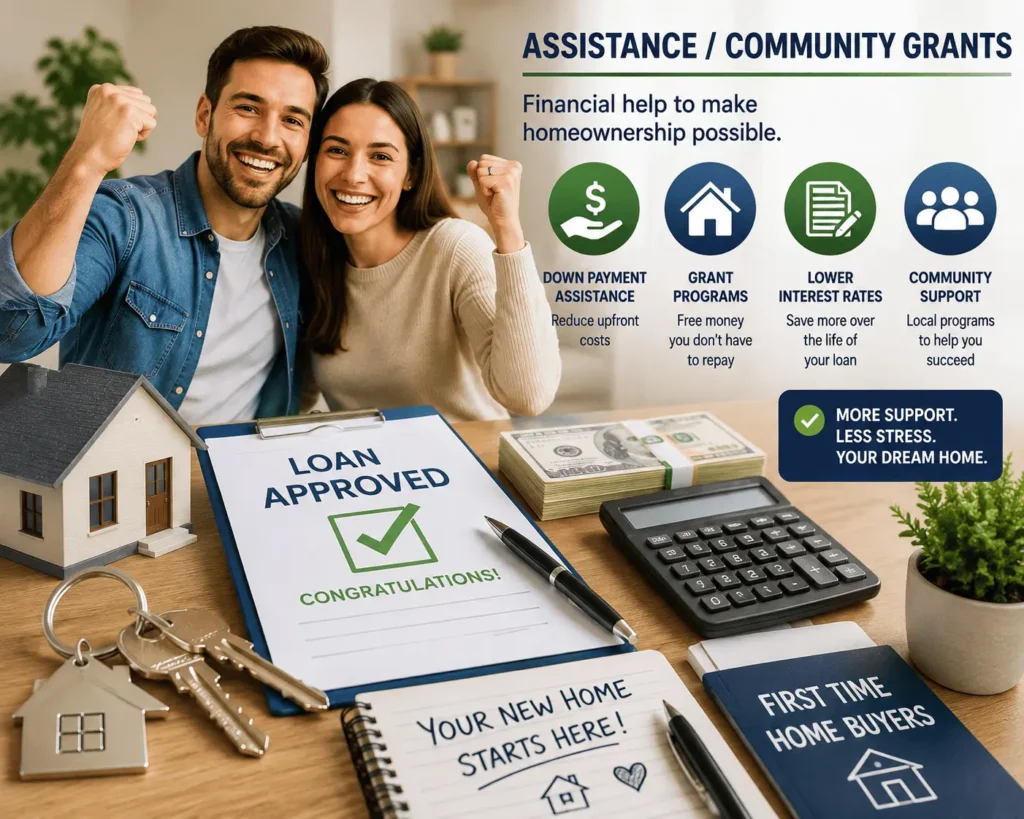
Here is a quick side-by-side look at the most common down payment help you will find within first time home buyer programs indiana currently offers:
| Program | Assistance Amount | Forgiveness Period | Buyer Type |
|---|---|---|---|
| First Place | Up to 6% of purchase price | 9 years | First-time buyers only |
| Next Home | Up to 3.5% (FHA) or 3% (conventional) | 2 years | First-time and repeat buyers |
| Helping To Own (H2O) | Up to 3.5% of loan amount | Varies by lender | First-time buyers only |
| Local City Programs | Up to $10,000 | Varies by city | Usually first-time buyers |
Details
Each program listed above runs through IHCDA-approved lenders rather than the state agency directly. You cannot apply straight through IHCDA itself. Instead, you pick an approved lender, and they handle your paperwork alongside your regular mortgage application.
Income limits change by county and household size. A family of four in Marion County may qualify at a different income level than that same family in a smaller, rural county.
Purchase price limits work the same way. A modest home in a rural county might sit well under the cap, while the same size home in a growing suburb could push closer to the limit. Your lender checks these numbers automatically once you apply.
Some funding provided by
Funding for these programs comes from a mix of sources. State bond proceeds, federal HOME funds, and local city budgets all feed into the pool of money used for down payment help.
Because funding is limited each year, some programs pause once their yearly allocation runs dry. Applying early in the year usually improves your odds of getting funded.
If a program you want is temporarily paused, ask your lender about backup options. Many buyers simply shift to a different program or wait for the next funding cycle, which often opens again within a few months.
Community Grants
Beyond state-run programs, many Indiana communities offer their own grants through nonprofit partners and local banks. These grants rarely require any repayment at all.
Community grants often target specific groups, such as teachers, healthcare workers, or veterans. Some employers even offer matching grants for staff buying their first home nearby. It is worth asking your HR department whether anything like this exists at your workplace.
Local nonprofits, such as regional habitat organizations and neighborhood housing partnerships, also run their own grant programs. These groups often work alongside IHCDA rather than replacing it, so ask your lender whether any local nonprofit grants apply to your first time home buyer programs indiana search before you finalize your budget.
Affordable Loan Options
Aside from government-backed loans, several lenders offer their own affordable loan products built for first-time buyers. These often include reduced fees, flexible credit requirements, and smaller required down payments.
Credit unions across Indiana frequently offer some of the best rates for first-time buyers, since they are member-owned and less profit-driven than large banks. Comparing at least three lenders before you commit is always worth the extra effort.
Community banks are another option worth checking, especially in smaller Indiana towns. They often know the local market well and may offer more flexibility on underwriting than a large national bank. You can explore more local resources through First Time Home Indiana as you compare your options.
Before signing with any lender, ask for a written breakdown of fees and rates. Comparing loan estimates side by side is the clearest way to spot which lender truly offers the strongest deal within first time home buyer programs indiana for your situation, rather than relying on advertised rates alone.
Which Program is Right for You?
Choosing the right program depends on your credit score, your savings, and how long you plan to stay in the home. Finding the best first time home buyer programs in indiana usually comes down to matching your situation to the right fit rather than picking the flashiest option.
- If you have little saved: First Place or an FHA loan may fit best
- If you might move again soon: Next Home offers faster forgiveness
- If you are a veteran: A VA loan skips the down payment entirely
- If you live in a rural area: A USDA loan could mean zero down
There is no single right answer for every buyer. A loan officer familiar with Indiana programs can run the numbers for your exact situation and show you the real monthly payment difference between two or three options.
Steps to buying your first home in Indiana
Buying your first home can feel overwhelming, but breaking it into small steps makes it manageable. Every first time home buyer programs indiana applicant follows roughly the same path, no matter which loan they choose.
- Check your credit score and fix any errors you find
- Set a realistic budget based on your income and monthly debts
- Get pre-approved with an IHCDA-approved lender
- Research which down payment assistance programs you qualify for
- Complete a homebuyer education course if your program requires one
- Start house hunting within your approved price range
- Make an offer and schedule a home inspection
- Close on your loan and collect your keys
Each step above builds directly on the last one. Skipping pre-approval, for example, often leads to wasted weekends looking at homes outside your real budget.
Give yourself more time than you think you need. Most first-time buyers spend two to four months searching before finding the right home, and another thirty to sixty days moving through closing. Rushing any single step tends to cause the most stress later on, so patience pays off here.
Keep a simple checklist as you go, and check off each step as you finish it. This small habit keeps the process from feeling like one giant, overwhelming task and turns it into something you can manage a little at a time.
Conclusion
Buying your first home in Indiana does not have to feel out of reach anymore. As promised at the start, this guide walked you through every major first time home buyer programs indiana option, from FHA and VA loans to IHCDA’s First Place and Next Home assistance. With the right program and a bit of planning, that down payment wall becomes much easier to climb. Reach out to a trusted lender today and take the first real step toward owning your home.
Frequently Asked Questions
What credit score do I need for first time home buyer programs indiana?
Most programs accept a credit score of 640 or higher, though FHA loans may accept scores as low as 580. Exact requirements vary by lender and by the specific program you choose.
Are free first time home buyer programs indiana options available?
Yes, several grants and forgivable loans require no repayment if you stay in the home long enough. Homebuyer education courses connected to these programs are often free as well.
How much down payment assistance can I get in Indiana?
First Place offers up to 6% of the purchase price. Next Home offers up to 3.5%, depending on your loan type and chosen lender.
Do I need to be a first-time buyer to qualify for every program?
Not always. Next Home also accepts repeat buyers, while First Place is reserved strictly for first-time buyers only.
Where do I apply for indiana first time home buyer programs ihcda options?
You apply through an IHCDA-approved lender rather than the state agency directly. Your lender submits the paperwork alongside your regular mortgage application.