
Ten thousand dollars. That is often the gap between your savings and what a lender wants at closing on a modest Indiana house. You have cut takeout, picked up weekend shifts, and the balance still crawls. Meanwhile prices climb each quarter, so the finish line keeps sliding forward.
Here is the part most buyers never hear. Indiana releases real money to people in your exact spot every year, and a large share goes unclaimed because nobody applies. This guide walks through the first time home buyer grants Indiana offers in 2026, from statewide funds to small city programs almost nobody talks about. By the end you will know which ones fit you, how much cash each frees up, and the order to apply in.
What is a first-time home buyer program?
A first-time home buyer program is help from a government agency, a bank, or a nonprofit that lowers the cash you need on closing day. It does not buy the house. It fills the gap between what you saved and what the lender wants up front.
That help comes in three shapes. Some give money you never pay back. Some lend money that disappears after you live in the home long enough. Some cut your tax bill instead.
Almost every one of the first time home buyer grants Indiana runs is tied to a mortgage. You pick an approved lender first, and the assistance rides along with your loan. Our breakdown of first time home buyer Indiana programs shows how these pieces fit together.
Who qualifies as a first-time home buyer?
The label is wider than it sounds. Under federal rules used across most Indiana programs, you count as a first-time buyer if you have not owned a main home in three years.
Three groups get the rule waived completely:
- Veterans and qualified service members, no matter what they owned before
- Buyers in targeted census tracts, including distressed ZIP codes such as 46208 in Indianapolis and 46805 in Fort Wayne
- Displaced homemakers and single parents who only ever owned a home with a former spouse
Beyond ownership history, most Indiana first time home buyers face three more tests. Household income must land under a county cap, the house must fall under a price cap, and you must live in it as your main home.
If you are helping a relative buy instead, a Family Opportunity Mortgage for a parent or disabled child may serve you better. Check your status with a lender first, because many first time home buyers in Indiana rule themselves out by guessing.
Indiana first time home buyer grants vs. down payment assistance loans
This is where most guides blur the line, and the difference decides whether you keep the money. A grant is a gift. A down payment assistance loan is money recorded against your title that can be called back. Both feel free on closing day, but only one stays free if your life changes in year three.
The table below sorts the main first time home buyer grants Indiana buyers reach for, plus the loans people confuse with them.
| Program | Amount | Grant or loan | Do you repay it? | Who it fits |
| IHCDA Helping to Own (H2O) | 3.5% of purchase price | Grant | No repayment required | First-time buyers using FHA |
| IHCDA First Place | Up to 6% of purchase price | Forgivable second mortgage | Yes, if you sell or refinance inside 9 years | Buyers needing the largest state help |
| IHCDA Next Home | 3% conventional, 3.5% FHA | Forgivable second mortgage | Yes, inside the affordability term | Repeat buyers and first-timers |
| IHCDA Honor Our Vets | $5,000 | Incentive with a VA loan | No | Veterans and service members |
| FHLBank Launch | Up to $20,000 | Grant | No, after the retention term | Households at or below 80% AMI |
| FHLBank HomeBoost | Set annual award | Grant | No, after the retention term | First-generation, first-time buyers |
| HOPE of Evansville | Up to $15,000 match | Grant | No | Buyers inside Evansville city limits |
Numbers change each funding year, so confirm current figures with the agency before you write an offer.
True grants you never repay
Among the first time home buyer grants Indiana approves each year, only a handful are true grants. A true grant carries no monthly payment, no interest, and no balloon at the end. IHCDA’s Helping to Own program is the clearest example, handing over 3.5% of the purchase price with nothing owed back.
The bank grants work the same way. Launch and HomeBoost pay out through member lenders and stay with you once the short retention period passes. Grants for first time home buyers Indiana cities fund, such as HOPE in Evansville, simply match what you put in.
One catch remains on grants tied to tax-exempt bond financing. A federal recapture tax can apply if you sell inside nine years and your income jumped a lot.
Forgivable loans that only become free after 9 years
First Place and Next Home are not grants, though plenty of websites label them that way. They are second mortgages recorded against your home at zero interest with no monthly payment.
Live there for the full term, usually nine years, and the balance is wiped out. Break the term and the full amount comes due. Three things break it: selling, moving out, or choosing to refinance your mortgage.
That last one surprises people. Rates drop two years later, refinancing looks smart, then the payoff statement shows an extra $12,000 owed. So the real question is not which program pays most, but how long you plan to stay. Short timeline, take the grant; long timeline, the bigger forgivable loan usually wins.
Federal programs for first-time home buyers in Indiana
Before any state money enters the picture, you need a mortgage underneath it. Three federal loan types carry most first-time buyers, and each pairs with state help.
FHA loans
FHA is the workhorse of first-time lending. You can put down as little as 3.5% with a credit score of 580 or higher, and underwriting forgives thin credit files. The trade-off is mortgage insurance, paid up front and monthly, which stays for the life of most FHA loans.
For a first time home buyer in Indiana, FHA matters for another reason. Most first time home buyer grants Indiana administers are built around it.
USDA loans
USDA loans require zero down payment, and far more of Indiana qualifies than people expect. Large stretches outside Indianapolis, Fort Wayne, and Evansville sit inside eligible rural boundaries.
Two limits apply. Household income must stay under the county cap, and the property must sit in an eligible area on the USDA map. Because the down payment is covered, buyers here put assistance toward closing costs.
VA loans
If you served, this is almost always your best route. VA loans need no down payment, carry no monthly mortgage insurance, and usually price lower than FHA.
Indiana adds a bonus. Honor Our Vets pairs a VA loan with a $5,000 incentive for closing costs, prepaids, or moving expenses. Veterans also skip the first-time buyer test on most state programs.
State programs for first-time home buyers in Indiana
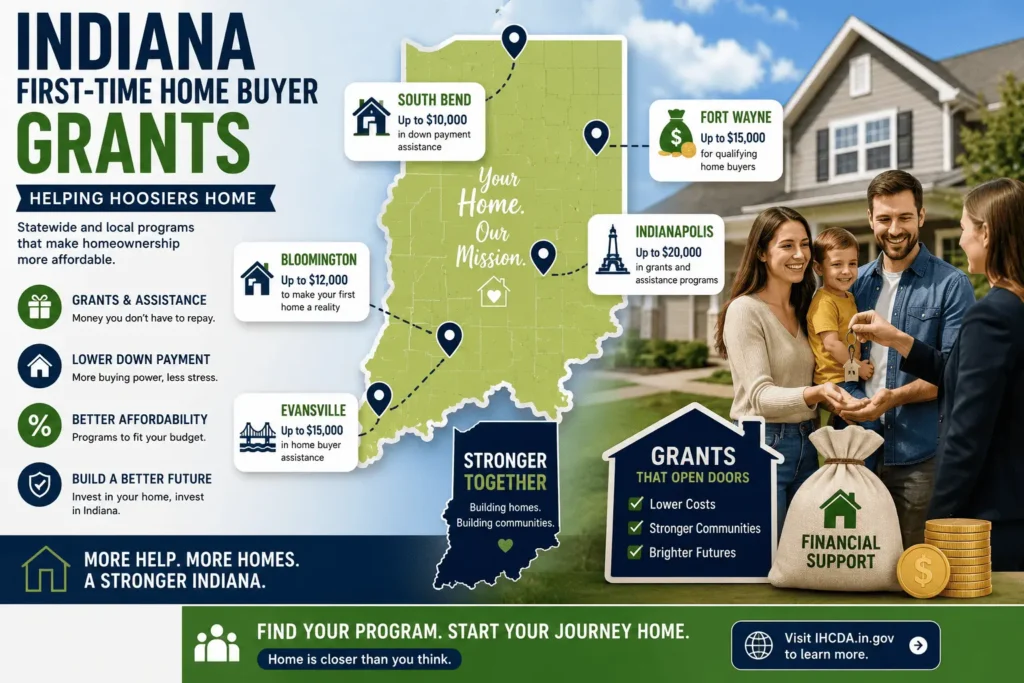
Indiana runs most first time home buyer grants Indiana residents use through a single agency, and understanding it is most of the battle. Questions about which file fits you can go to james@allthings-mortgage.com.
Indiana Housing and Community Development Authority (IHCDA) loans
IHCDA offers 30-year fixed mortgages bundled with assistance, and it sits behind most first time home buyer grants Indiana buyers receive. It does not lend directly; it sets the rules and lets approved lenders originate the loans.
Every product shares a base set of rules. You need a 640 credit score with a debt-to-income ratio under 45%, or 680 if your ratio runs between 45% and 50%. Education is required on most products, and income and price caps apply by county. Below are the five indiana first-time home buyer programs that matter most.
First Place Program
First Place is the largest single piece of help the state offers, providing up to 6% of the purchase price. On a $250,000 home that is $15,000 you do not pull from savings.
It arrives as a zero-interest second mortgage with no monthly payment. You must be a first-time buyer, a qualified veteran, or buying in a targeted census tract, and it pairs with a 30-year fixed FHA or conventional loan.
The forgiveness clock is the piece to plan around. Stay nine years and it disappears; leave early and you write a check.
Next Home Program
Next Home is the flexible option, giving 3% of the purchase price on conventional financing or 3.5% on FHA as a forgivable second mortgage.
The headline feature is who can use it. You do not have to be a first-time buyer, which makes it the go-to for people who owned years ago and are starting over. It can also pair with a Mortgage Credit Certificate.
Mortgage Credit Certificate (MCC)
The MCC is the most overlooked tool in the state. Instead of cash at closing, it gives you a federal tax credit every year you hold the mortgage.
The credit equals up to 25% of the mortgage interest you paid, capped at $2,000 a year. Over a 30-year loan that totals tens of thousands. It costs roughly $800 to apply, and most households recover that in year one.
One restriction: the MCC is for first-time buyers only, unless you buy in a targeted area. It is a credit, not a deduction, so it cuts your tax bill dollar for dollar.
Helping to Own (H2O)
H2O is the only IHCDA product that is a true grant. It provides 3.5% of the purchase price with no repayment at all, which makes it the strongest choice for anyone who might move within a few years.
It pairs exclusively with an FHA loan through an approved lender and needs the standard 640 score plus completed education. If you qualify for only one Indiana first time home buyer grant, chase this one.
Honor Our Vets (HOV)
HOV exists for veterans, active-duty members, and qualified reservists, layering a $5,000 incentive on top of a VA loan. The money is flexible: closing costs, prepaid taxes and insurance, the down payment, or relocation. Previous homeownership does not disqualify you; service history is what counts.
Community Grants
State money is only half the story. Some of the best local funds never appear on a state website. Cities and counties run their own pots, paid for with federal Community Development Block Grant and HOME dollars.
These are smaller but far less crowded, and many go unspent. First-time home buyer Indiana grants at the city level each carry their own income cap, price cap, and map. Grants for first time home buyers in Indiana cities almost always require the home to sit inside city limits.
Indianapolis (INHP / Indy HomeBuyer)
Indianapolis has the deepest local resources in the state. The Indiana Housing Partnership offers roughly $7,500 to $25,000 for buyers using its own loan products.
The city program targets households below 80% of area median income inside Marion County, with awards reported up to $15,000. HUD limits set the ceiling, recently near $88,550 for a family of four. Both routes require counseling first, which takes weeks.
Fort Wayne (Hoosier Homes)
Fort Wayne is the tightest market on this list. Hoosier Homes, run through the local housing authority, offers up to 5% of the purchase price as a forgivable second mortgage on a seven-year term.
It covers Allen, DeKalb, and surrounding northeast Indiana counties, and unusually it carries no first-time buyer requirement. The city also runs a separate forgivable option reported at up to $10,000, with a 620 minimum score and an 80% AMI cap.
Evansville (HOPE of Evansville + City program)
Evansville offers the most generous stacking opportunity in Indiana, because two programs run side by side and eligible buyers can use both.
HOPE of Evansville provides a matching grant of up to $15,000, the most generous city-level first time home buyer grant Indiana has. You contribute at least $1,000 and the program matches it. Recent price caps sat near $174,000 for existing homes and $255,000 for new builds.
The City of Evansville program adds a forgivable loan capped at $40,000, forgiven over 5, 10, or 15 years. Both require an education course.
South Bend, Bloomington, and Gary
South Bend runs one of the boldest structures in the state: a forgivable second mortgage covering up to 20% of the purchase price, wiped clean after five years. It targets buyers at or below 80% of area median income.
Bloomington’s down payment and closing cost program serves buyers inside city limits who have not owned in three years.
Gary works through the Homeownership Opportunity Network. Funding shifts year to year, so confirm status before planning around it.
Affordable Loan Options
Indiana first time home buyer finance options are not limited to grant programs. Some buyers earn slightly too much to clear the income caps.
Fannie Mae HomeReady and Freddie Mac Home Possible both allow 3% down. Both price mortgage insurance lower than a standard conventional loan, and both cancel it once you reach 20% equity, which FHA does not.
Many banks also run their own products with reduced fees or lender credits, which rarely show up in search results. Comparing loan types and approval requirements side by side is worth an afternoon.
Launch – Down Payment Assistance
Launch is the largest single grant available to Indiana buyers, and it comes from FHLBank Indianapolis rather than the state. It provides up to $20,000 toward your down payment, closing costs, counseling fees, and buyer-broker fees.
Among Indiana grants for first time home buyers, this one is the simplest to qualify for. Your household must earn at or below 80% of area median income, be a first-time buyer, finish education, and contribute at least $500.
The 2026 round carried $7.9 million and opened April 14, first-come, first-served. You cannot apply directly; Launch flows through participating banks and credit unions. It also stacks with IHCDA products, making it the highest-value option among the first time home buyer grants Indiana buyers can access.
FHLBank Indianapolis HomeBoost (first-generation buyers)
HomeBoost is a first time home buyers grant Indiana created for a group nobody else serves. You must be both a first-time buyer and a first-generation buyer, meaning your parents never owned a home in the United States. The definition also covers buyers who aged out of foster care or became emancipated.
The 2026 round carried $5.3 million and opened July 8. Like Launch, it runs through member institutions, requires a $500 contribution, and carries no repayment. One difference matters: manufactured housing is eligible under Launch but not under HomeBoost.
Income limits, credit score, and purchase price limits for Indiana grants
Three numbers decide almost every application for first time home buyer grants Indiana agencies fund. Get all three right and approval is usually routine.
Income. Most programs cap household income between 80% and 150% of area median income. Income counts everyone in the household, not just people on the loan.
Credit and debt. IHCDA sets 640 as the floor with a debt-to-income ratio under 45%, rising to 680 if your ratio falls between 45% and 50%. Some local programs accept 620.
Purchase price. Every program caps the home price by county and by whether the property is new or existing. Evansville’s caps run well below the statewide ceiling.
A fourth requirement is not a number. Nearly every program here requires a HUD-approved education course, and most lenders will not reserve funds until your certificate is on file.
Can you stack multiple grants together?
Yes, and this is where the real money is. Most first time home buyer grants Indiana offers are designed to layer, and the typical stack is one state program plus one local program plus a Mortgage Credit Certificate.
Two conditions must hold. Your lender must participate in every program you combine, and total assistance cannot exceed what the programs allow together. Some funds also block pairing with specific partners, so reservation order matters.
Evansville shows what stacking produces: the city forgivable loan plus the HOPE match can exceed $50,000 inside city limits. Ask your lender to write out the full stack before you make an offer, or send it to james@allthings-mortgage.com for a second opinion.
Helping Hoosiers Find Homes
Indiana funds a statewide network of housing counselors, and their advice costs you nothing.
A HUD-approved counselor does more than issue your certificate. They know which local funds still have money left this quarter, which lenders actually close these loans, and which employer-assisted housing benefits exist in your county. Hospitals, universities, and large employers sometimes offer help that never appears online.
Homeownership Initiatives .GIVES
Indiana also supports nonprofit initiatives aimed at long-term ownership. Habitat for Humanity affiliates, community land trusts, and neighborhood development corporations operate across the state.
These groups work differently from lenders. Some build homes and sell them below market. Others hold the land and sell only the house, which keeps the price permanently lower.
For Homebuyers
IHCDA publishes an approved lender directory, income and acquisition limits by county, and program guides, free on its website. Use the lender list first, because a lender who closes these loans weekly is the biggest predictor of a smooth closing.
Gather two years of tax returns, 60 days of pay stubs, two months of bank statements, and photo ID. Assistance underwriting asks for more paperwork than a standard loan, so a complete file moves faster.
Steps to buying your first home in Indiana
Order matters more than speed, because the most common failure is finding a house before your funding is locked.
- Check your credit and clean it up. Moving from 620 to 640 unlocks a whole tier of programs.
- Set a real budget. Run your numbers through a mortgage calculator before an agent tells you what you can afford.
- Complete homebuyer education. Almost every program requires the certificate, and it can take several weeks.
- Pick an approved lender and get pre-approved. The lender decides which programs you can access.
- Reserve your assistance funds. Your lender submits the reservation, and money is first-come, first-served.
- Shop inside your program’s limits. A house $2,000 over the cap does not qualify.
- Budget for homeowners insurance and escrow. These get collected at closing.
- Close, then watch your mail. Your loan can transfer to a new servicer within months.
Keep every assistance document in one place. If you ever refinance or sell, you will need the original terms to work out what you owe.
How to apply for first time home buyer grants Indiana offers
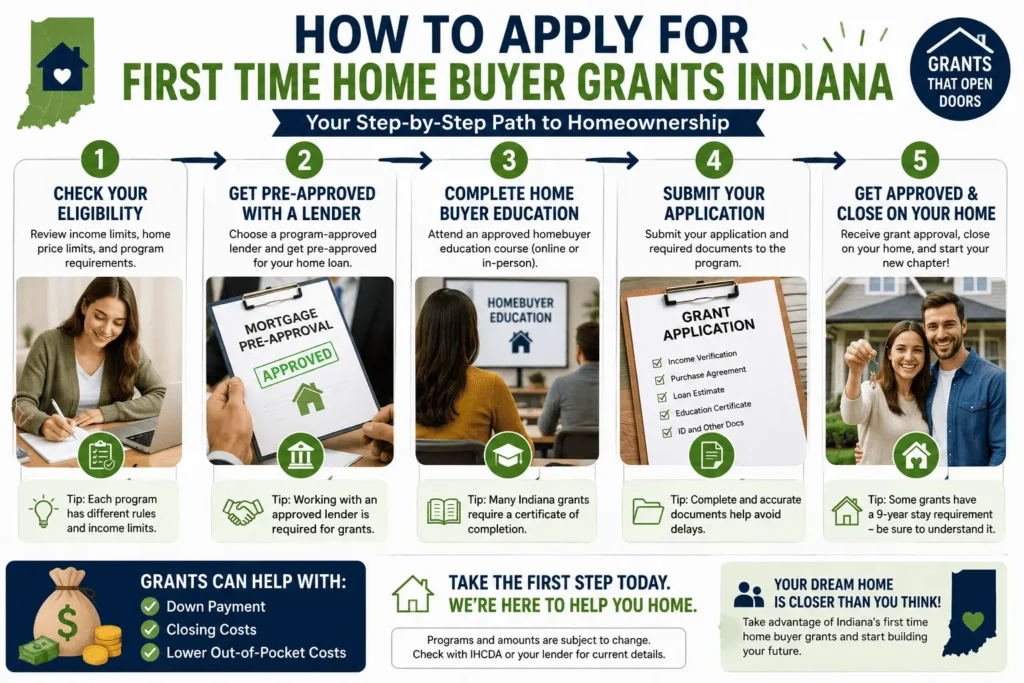
There is no central application and no way to apply to the state directly. Every program here is reserved by a lender on your behalf, which makes lender selection the whole game.
Pull the IHCDA approved lender list and call three. Ask which programs they are reserving now, how many assistance loans they closed last year, and what overlays they add.
Then compare terms, and take time to compare mortgage rates, because a rate a quarter point higher can cost more over ten years than the grant gave you. Also confirm how each handles your monthly payment and escrow setup after closing. Submit your document package the day you get pre-approved, because incomplete files lose their place in line.
2026 funding deadlines you can’t miss
Timing separates funded buyers from waitlisted ones. Grant money is not a standing entitlement; it opens in rounds and closes when the allocation runs out. The 2026 Launch round opened April 14 with $7.9 million, and HomeBoost opened July 8 with $5.3 million.
Local city funds usually reset at the start of the municipal fiscal year, and several run dry by midsummer. IHCDA products run year-round, but limits get updated, so figures you saved six months ago may be stale.
Practical rule: have your lender chosen, your certificate issued, and your documents uploaded at least three weeks before a round opens.
Contact us today to learn more about each program!
Reading about assistance and reserving it are two different jobs. Rules shift by county, rounds open and close, and the fastest way to lose money you qualified for is to guess.
Send your questions to james@allthings-mortgage.com with your county, rough household income, and target price range. You will get a straight answer about which options fit, not a sales pitch. You can also read more about our team or see our complete guide to loans, rates, and online loan management.
Conclusion
At the start, the promise was simple: show which programs exist, what each pays, and how to claim them in order. That map is now yours, from H2O and First Place to the city funds in Evansville and South Bend. The first time home buyer grants Indiana offers are real, funded now, and mostly unused because nobody applies. Pick your lender this week, finish your certificate, and get in line before the next round closes.
Frequently asked questions
Do I have to pay back a down payment grant in Indiana?
True grants such as H2O, Launch, and HomeBoost require no repayment. Forgivable second mortgages like First Place and Next Home must be repaid if you sell, move out, or refinance before the term ends.
How much money can a first-time buyer get in Indiana?
The first time home buyer grants Indiana offers range from 3% to 6% of the purchase price. Adding a bank grant and a local city fund can push total assistance past $30,000, and Evansville stacking can exceed $50,000.
What credit score do I need for Indiana assistance programs?
IHCDA requires a minimum 640 score with a debt-to-income ratio under 45%, or 680 if your ratio runs from 45% to 50%. Some local city programs accept 620. Individual lenders may set higher standards.
Can I use a grant if I owned a home before?
Sometimes. Next Home and Fort Wayne’s Hoosier Homes have no first-time requirement. Veterans and buyers purchasing inside targeted census tracts are also exempt from the three-year ownership rule on most state products.
How long does the application process take?
Plan on 45 to 60 days from pre-approval to closing. Homebuyer education adds two to four weeks up front, and assistance underwriting typically adds one to two weeks compared with a standard mortgage.