Buying a home in Arkansas, Kansas, Missouri, or Oklahoma means you have probably already heard the name Arvest. But when it comes to getting a fair rate on your home loan, most borrowers hit the same wall — numbers that change daily, loan types that all sound the same, and no clear answer on what they will actually pay. That confusion costs people real money every single year.
This guide breaks down Arvest mortgage rates loan by loan, explains every factor that moves your rate up or down, covers what you will pay in closing costs, and shows you exactly how to lock in the best deal before the market shifts again.
What Are Arvest Mortgage Rates
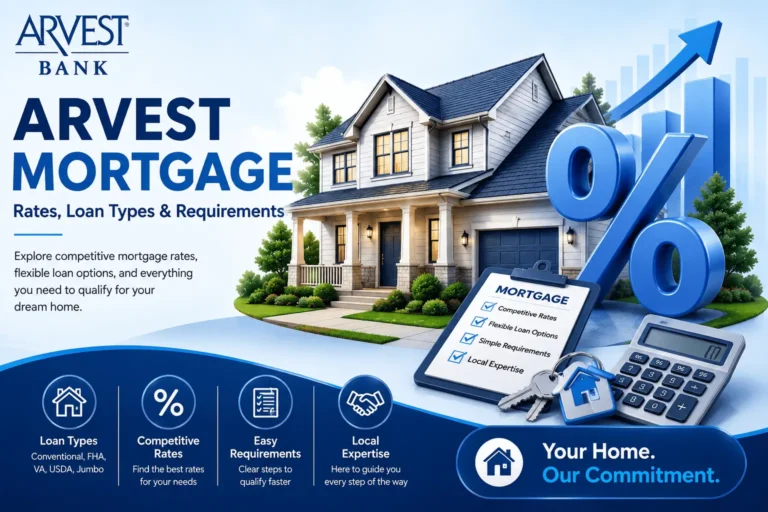
Arvest mortgage rates are the interest rates Arvest Bank and Arvest Central Mortgage charge on home loans across their four-state service area. These are not fixed numbers sitting on a public page waiting for you to copy them down. They shift every business day based on bond market movement, federal policy, your credit profile, loan type, and property location.
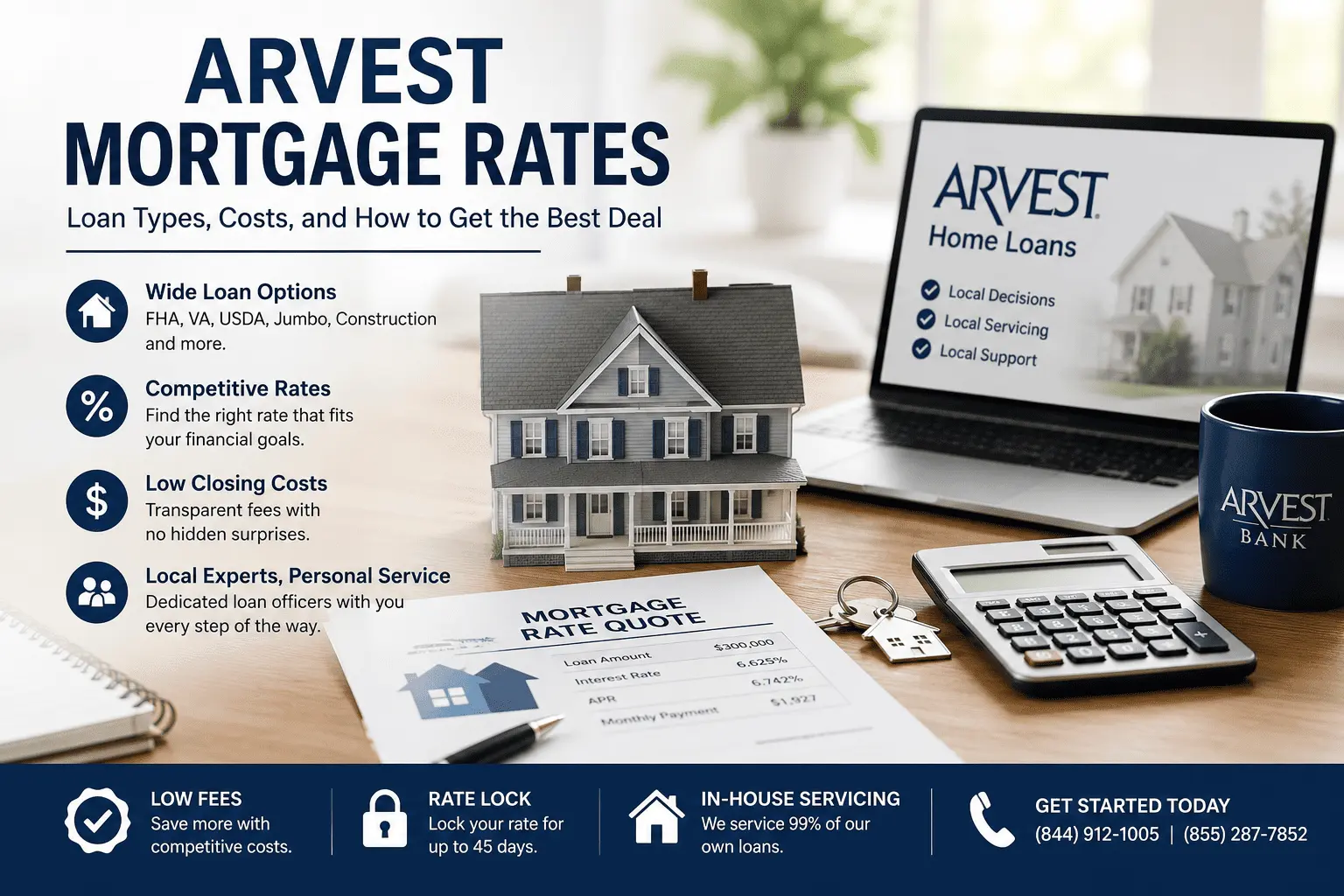
Arvest Central Mortgage is the dedicated lending division of Arvest Bank. It operates under NMLS #186891 and is headquartered in Little Rock, Arkansas. What makes Arvest different from most large lenders is that it services 99% of the loans it originates. Your loan does not get sold off to a third-party company after closing. You deal with Arvest from application all the way through payoff.
Advertised rates are based on a 45-day lock period and apply only to purchase transactions on owner-occupied single-family homes. Loans are not available in Delaware, Maryland, New Hampshire, New York, and Rhode Island. To get your actual quoted rate, you need to contact a loan officer directly or enter your ZIP code on the Arvest website.
Arvest Mortgage Loan Types and Rates
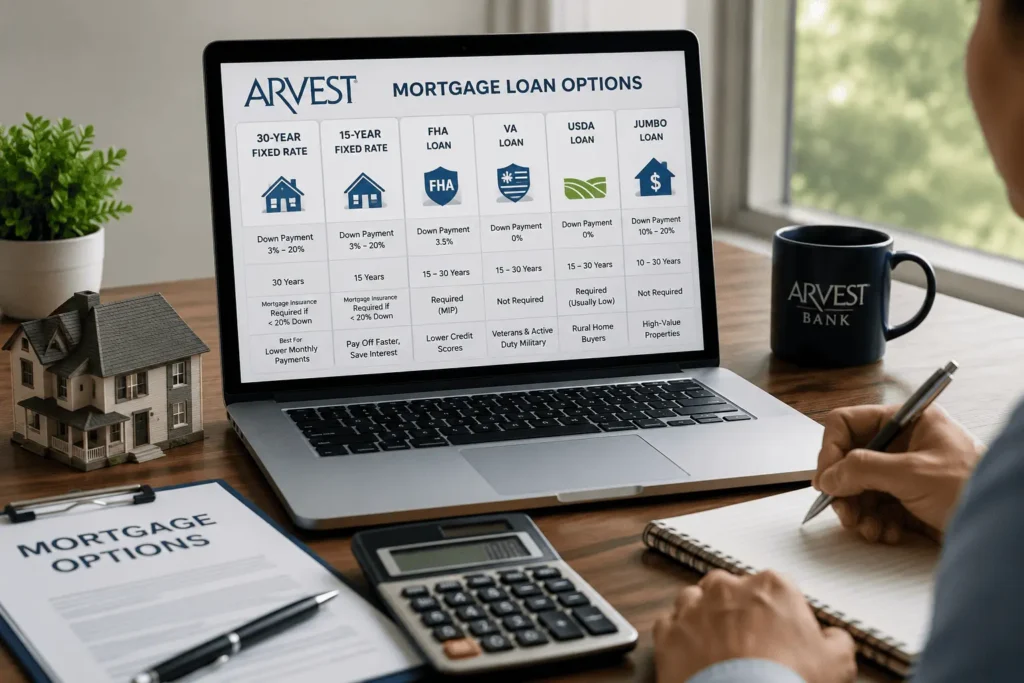
Arvest offers one of the broadest loan menus among regional community banks. Whether you are a first-time buyer, a veteran, a rural homebuyer, or purchasing a high-value property, there is a loan structure built for your situation.
30-Year Fixed-Rate Mortgage
The 30-year fixed loan is the most common home loan in the country. Your rate and monthly payment stay the same for the entire loan term, which makes long-term budgeting straightforward. Arvest’s average 30-year fixed rate in 2024 was 6.74%, compared to the national average of 6.55% — a gap of 0.19%. This loan works best for buyers who plan to stay in their home for many years and want payment stability over everything else.
15-Year Fixed-Rate Mortgage
A 15-year fixed loan carries a lower interest rate than its 30-year counterpart. Monthly payments are higher because you are paying off the same loan amount in half the time. However, the total interest paid over the life of the loan is significantly less. This is a strong option for buyers with higher monthly income who want to build home equity fast and reduce their long-term borrowing cost.
Adjustable-Rate Mortgage (ARM)
An ARM from Arvest starts with a fixed introductory rate for 3, 5, 7, or 10 years depending on the loan terms. After that initial period ends, the rate adjusts once per year based on current market conditions. The opening rate on an ARM is typically lower than a fixed-rate loan, which reduces your early monthly payments. This product works well for buyers who plan to sell or refinance before the adjustment period begins.
FHA Loan Rates
FHA loans are backed by the Federal Housing Administration and designed for buyers who need more flexible qualification standards. Arvest accepts credit scores as low as 580 with a minimum down payment of 3.5%. A credit score between 500 and 579 requires a 10% down payment. Every FHA loan carries an upfront mortgage insurance premium of 1.75% added to the loan balance, plus a monthly MIP for the life of the loan. Despite the insurance cost, FHA rates at Arvest are competitive and the lower down payment requirement makes this one of the most accessible loan options available.
VA Loan Rates
VA loans are available to active-duty military members, veterans, and eligible surviving spouses. Arvest offers VA loans with zero down payment and no monthly mortgage insurance requirement. Qualified borrowers can also use VA financing for 100% of a refinance transaction. A one-time VA funding fee applies — ranging from 1.25% to 2.15% on first use depending on down payment amount. VA loans consistently offer some of the lowest effective rates available because of the government backing behind them.
USDA Rural Development Loan Rates
USDA loans help buyers purchase homes in areas designated as rural by the U.S. Department of Agriculture. Arvest offers these loans with zero down payment and 100% financing. Monthly mortgage insurance costs on USDA loans are lower than FHA loans, making the total monthly payment more affordable for eligible buyers. Income limits apply based on household size and county, and the property must be located in a USDA-eligible zone to qualify.
Jumbo and Blended Jumbo Loan Rates
Jumbo loans at Arvest cover home purchases above the conforming loan limit of $832,750. These loans are available in both fixed-rate and adjustable-rate structures. Because of the larger loan size and higher lender risk, jumbo rates typically run slightly higher than conforming loan rates. Arvest also offers a Blended Jumbo product that combines a standard first mortgage with a home equity line of credit. This two-layer approach can lower the effective rate on the overall financing compared to carrying one large jumbo loan alone.
Construction Loan Rates
Arvest provides fixed-rate construction loans for buyers building a new home from the ground up. The loan covers land purchase, construction costs, materials, and home plans under one financing structure. During the build phase, borrowers have the option to make interest-only payments, which keeps cash flow manageable while the home is being built. Arvest funds up to 100% of total construction costs or 80% of the appraised value, whichever is lower. Once construction is complete, the loan transitions into a permanent mortgage.
Physician Loan Rates
Physician loans at Arvest are built specifically for new medical residents and practicing doctors who are early in their careers. These loans do not require private mortgage insurance, even with a lower down payment. Underwriting guidelines are more flexible to account for the unique income structure of medical professionals, including deferred student loan debt. This product fills a real gap for high-earning borrowers who do not yet have years of traditional employment history on paper.
What Affects Your Arvest Mortgage Rate
Your rate is not assigned randomly. Several specific borrower and loan factors determine what number your loan officer quotes on the day you apply.
Credit Score
Credit score is the single biggest factor in your quoted rate. Conventional loans at Arvest require a minimum score of 620. FHA loans accept 580. A borrower with a 760 score will almost always get a lower rate than one with a 680 score on the same loan type. Even a 20 to 30 point improvement before applying can meaningfully reduce your monthly payment.
Loan-to-Value Ratio
Your loan-to-value ratio compares your loan amount to the appraised value of the home. A lower LTV means less risk for the lender and a better rate for you. Putting 20% or more down eliminates private mortgage insurance on conventional loans and usually unlocks better rate pricing at the same time.
Debt-to-Income Ratio
Arvest allows a maximum DTI of 45%. However, borrowers who keep their DTI below 36% typically qualify for better rate tiers. This ratio is calculated by dividing your total monthly debt obligations by your gross monthly income. Paying down credit cards or auto loans before applying directly improves this number.
Loan Type and Term
Government-backed loans like FHA, VA, and USDA carry different rate structures than conventional loans. Shorter loan terms like 15 years almost always come with lower rates than 30-year terms because the lender gets repaid faster. The product you choose has a direct effect on your quoted rate from day one.
Rate Lock Timing
Mortgage rates move every single business day. Once you and your loan officer agree on loan terms, you sign a rate-lock agreement that freezes your rate for up to 45 days. Skipping this step or waiting too long to lock leaves you exposed to rate increases before your closing date.
| Credit Score Range | Estimated Rate | Monthly Payment on $300K Loan |
|---|---|---|
| 760 and above | ~6.50% | $1,896 |
| 700 to 759 | ~6.75% | $1,946 |
| 660 to 699 | ~7.25% | $2,045 |
| 620 to 659 | ~7.75% | $2,149 |
Arvest Mortgage Closing Costs and Fees

Closing costs at Arvest average around $5,077 for a standard 30-year fixed loan. This figure represents the total out-of-pocket amount due at closing beyond your down payment. Arvest is generally classified as a low-fee lender, which means its slightly higher rate is often offset when you look at the full cost picture.
| Cost Item | Estimated Amount |
|---|---|
| Loan origination fee | Varies by loan amount |
| Appraisal fee | $400 to $600 |
| Credit report fee | $25 to $50 |
| Title insurance and fees | $500 to $1,500 |
| Prepaid homeowners insurance | One year upfront |
| Property tax escrow | 2 to 3 months |
| FHA upfront MIP | 1.75% of loan amount |
| VA funding fee | 1.25% to 2.15% |
Arvest does not publish a complete fee schedule publicly. You must request a formal Loan Estimate from your loan officer to see the exact line-by-line breakdown for your specific loan. Conventional borrowers who put down less than 20% will also pay private mortgage insurance until their loan balance reaches 80% of the home’s appraised value.
Arvest Mortgage Refinance Options
Refinancing with Arvest gives existing homeowners a path to reduce their current interest rate, shorten their loan term, or access equity they have built over time.
A rate-and-term refinance replaces your existing loan with a new one at better terms. Dropping your rate by even 0.50% can save thousands of dollars over a full loan term. Cutting ten years off your repayment schedule builds equity significantly faster in the early years of the new loan.
A cash-out refinance lets you borrow against your home’s current market value and receive the difference as a lump sum at closing. This works well for consolidating high-interest debt, funding home improvements, or covering major expenses. Arvest also offers FHA and VA streamline refinances for borrowers who already have government-backed loans and want to lower their rate with less paperwork and no new appraisal required. A HELOC is available as a flexible alternative for borrowers who want access to equity without replacing their existing mortgage entirely. Note that advertised purchase rates do not apply to refinance transactions — your loan officer will give you separate pricing based on your current balance and financial profile.
How Arvest Mortgage Rates Compare to Other Lenders
Arvest’s 2024 average 30-year fixed rate came in at 6.74% against a national average of 6.55%. That 0.19% difference may seem small but adds up considerably over a 30-year repayment period on a large loan balance.
The more complete comparison includes total loan cost, not just the rate. Arvest is a low-fee lender, meaning lower closing costs partially offset the rate difference when you calculate the real cost of borrowing. National online lenders sometimes advertise lower headline rates but charge higher origination fees and often sell your loan to a third-party servicer after closing.
Arvest services 99% of its own loans, which means post-close customer support stays consistent and local. Borrowers in Arkansas, Kansas, Missouri, and Oklahoma benefit from loan officers with direct knowledge of local housing markets, property values, and regional qualification nuances that national lenders simply do not have. Arvest’s pick rate is slightly below average compared to similar lenders, so pulling Loan Estimates from two or three sources before making a final decision is always the right move.
How to Get a Lower Arvest Mortgage Rate
Small steps taken before you apply can result in a meaningfully better rate on closing day.
Raise your credit score before submitting your application. Even a 20 to 30 point improvement can move you into a better rate tier and reduce your monthly payment. Pay down revolving credit card balances first as they have the fastest impact on your score.
Increase your down payment if your savings allow it. A lower loan-to-value ratio reduces lender risk and typically unlocks better pricing. Getting from 10% down to 20% down eliminates PMI and usually improves your rate at the same time.
Reduce your debt-to-income ratio before applying. Pay off smaller debts like car loans or personal loans to bring your monthly obligations down. Lenders reward borrowers who show strong cash flow relative to their total debt load.
Compare Loan Estimates from at least two or three lenders before committing to Arvest. The Loan Estimate is a standardized document that makes side-by-side comparison of rates, fees, and total costs straightforward. Focus on the APR column rather than just the interest rate because APR reflects the true cost of the loan including all fees.
Lock your rate as soon as your terms are agreed upon. Rates move daily and waiting too long to lock can cost you a higher payment if the market shifts upward before your closing date.
How to Apply and Lock Your Arvest Mortgage Rate
The Arvest application process is built around a dedicated loan officer relationship from start to finish. You are not passed between departments or left managing your loan through an automated portal alone.
Start by prequalifying online or through the Arvest Home4Me mobile app. This gives you a preliminary picture of what you qualify for before you start making offers on homes. Submit your full application with W-2s, recent pay stubs, two months of bank statements, and your employment history.
Your loan officer reviews your credit score, DTI, LTV, and chosen loan type to determine qualification and rate options. An independent appraisal is then ordered to confirm the property’s market value matches the loan amount. Underwriting verifies all submitted documents before issuing a clear to close. Sign your rate-lock agreement with your loan officer to guarantee your quoted rate through closing. The full process from application to closing day typically runs 30 to 45 days. Contact Arvest at (844) 912-1005 or reach a local lender through the Home4Me app to get started.
Existing customers can also manage their loan online through the Arvest mortgage login portal, where they can review account details, loan documents, and payment information.
Is Arvest Mortgage Good for First-Time Homebuyers
Arvest is a genuinely strong option for first-time buyers, particularly within its regional footprint. FHA loans with 3.5% down make homeownership accessible for buyers who have not yet saved a large down payment. USDA loans offer zero down for buyers purchasing in eligible rural areas across Arkansas, Kansas, Missouri, and Oklahoma. The dedicated loan officer model means a first-time buyer has one consistent point of contact guiding them through every step rather than navigating a call center.
The Arvest Home4Me app gives first-time buyers the ability to prequalify, upload documents, and track their loan in real time from a mobile device. Local loan officers understand the housing markets in their communities and can advise on property values and neighborhood trends that matter during the offer process. First-time buyers should always request a full Loan Estimate and compare it with at least one other lender before signing anything.
Arvest Mortgage Pros and Cons
Pros:
- Services 99% of its own loans — no surprise transfers to unknown servicers after closing
- Wide loan menu covering FHA, VA, USDA, Conventional, Jumbo, Blended Jumbo, Construction, and Physician loans
- Dedicated loan officer from application to closing
- Low-fee lender structure offsets slightly higher rate on total cost basis
- Strong local market knowledge across AR, KS, MO, and OK
Cons:
- Live rates not displayed publicly — must contact a loan officer for a quote
- Service area limited primarily to four states
- 30-year fixed rate slightly above national average
- Below-average pick rate — comparison shopping is still recommended before committing
Since Arvest services most of its own loans, borrowers can conveniently make their Arvest mortgage payment through the same servicing platform after closing.
Conclusion
Arvest mortgage rates sit slightly above the national average on paper, but the full picture tells a different story. Lower closing costs, in-house loan servicing, a wide loan menu, and local market expertise combine to make Arvest a genuinely competitive choice for borrowers in its service area. Veterans, first-time buyers, rural homebuyers, physicians, and high-value property buyers all have purpose-built loan options here. If consistent service, loan stability, and local knowledge matter more to you than chasing the lowest headline rate, Arvest is a lender worth serious consideration.
Frequently Asked Question
Q1: Does Arvest Publish Its Mortgage Rates Online?
Arvest Central Mortgage posts daily sample rates for conventional, FHA, and VA loans on its website. The main Arvest Bank site requires a ZIP code entry or direct loan officer contact for location-specific pricing. Rates change every business day so any posted figure is a reference point, not a guaranteed quote.
Q2: What Is the Difference Between Interest Rate and APR at Arvest?
The interest rate is the base cost of borrowing. APR adds origination fees and closing costs into one yearly figure. Always compare APR across lenders because it reflects the true total cost of the loan, not just the base rate.
Q3: Can Self-Employed Borrowers Qualify for an Arvest Mortgage?
Yes. Self-employed borrowers typically need two years of tax returns, a profit and loss statement, and recent bank statements to verify income. Your loan officer will confirm the exact documents needed based on your business type and income structure.
Q4: What Is the Arvest Home4Me App and How Does It Help Borrowers?
The Arvest Home4Me app lets borrowers prequalify, upload documents, and track loan status from their phone. It gives real-time updates at every stage without requiring a call to your loan officer. First-time buyers especially benefit from this visibility.
Q5: How Does an Arvest Construction Loan Convert to a Permanent Mortgage?
During the build phase you make interest-only payments on funds drawn. Once construction is complete and the certificate of occupancy is issued, the loan converts to a permanent fixed-rate mortgage. Your loan officer manages the conversion and coordinates the final appraisal.