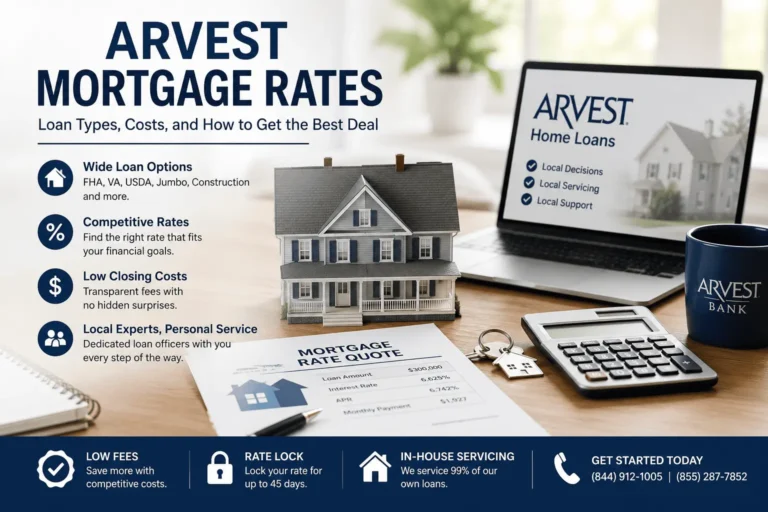
Picking a home lender feels harder than picking the home itself. One bank promises low rates, another promises fast closing, and you are stuck reading fine print at midnight. If Arvest Bank keeps showing up in your search, you are probably wondering if it deserves your trust and your money.
This guide answers that question with real details, not sales talk. We will break down every arvest mortgage loan option, the rates, the credit rules, the fees, and what real borrowers say. By the end, you will know exactly whether this lender fits your situation or not.
What Is Arvest Mortgage?
Arvest Mortgage is the home lending division of Arvest Bank, a community bank owned mostly by the Walton family. The bank started in Arkansas and has grown into one of the largest mortgage providers in its region. It has held the top spot for mortgage volume in Arkansas since 2001.
Here is what makes it different from big online companies. Arvest services about 99% of the mortgages it creates. That means the bank that approves you is the same bank you pay every month. Your account does not get sold to a stranger after closing, which is a common headache with other lenders.
The bank holds NMLS number 403249 and runs its mortgage division from Little Rock, Arkansas. Its history goes back to 1871, starting as McIlroy Bank & Trust. That long track record matters when you are trusting someone with the biggest purchase of your life. Few regional banks can match this mix of age, size, and family ownership.
Types of Arvest Mortgage Loans

Arvest offers a full menu of mortgage products, so most buyers can find a fit. Whether you have a big down payment or almost none, there is likely an option here. Below is what each arvest mortgage loan type offers and who it suits best.
Conventional Loans (Fixed and Adjustable Rate)
A conventional loan is the classic choice and is not backed by any government agency. You can pick a fixed rate, where your payment stays the same for 15 or 30 years. Or you can pick an adjustable rate, which locks your rate for the first 3, 5, 7, or 10 years. After that period, the rate adjusts once a year based on the market.
Fixed rates work best if you plan to stay in your home for a long time. Adjustable rates can save money if you plan to move or refinance within a few years.
FHA Loans
FHA loans are backed by the Federal Housing Administration, which makes them easier to qualify for. The down payment can be as low as 3.5% of the home price. Credit score rules are also more relaxed than conventional options.
The trade-off is mortgage insurance. FHA requires an upfront insurance premium of 1.75%, plus a monthly insurance charge. Still, for first-time buyers with limited savings, this path opens the door to owning a home.
VA Loans
VA loans are for veterans, active service members, and some military spouses. The U.S. Department of Veterans Affairs backs these mortgages. Most qualified borrowers can buy with zero down payment.
VA loans also skip private mortgage insurance completely. That alone can save hundreds of dollars every month compared to other low-down-payment choices.
USDA Rural Development Loans
USDA loans help buyers purchase homes in rural areas approved by the U.S. Department of Agriculture. Many small towns and outer suburbs count as rural, so do not assume you live too close to a city. These mortgages can offer zero down payment for buyers who meet income limits.
Jumbo Loans
A jumbo loan covers homes priced above the standard lending limits. If you are buying a high-value property, this is the route you will take. Expect stricter credit checks and a larger down payment, since the bank takes on more risk.
Construction Loans
Building a home instead of buying one? Arvest offers construction financing that covers the building phase and then converts to a regular mortgage. This is a real gap at many online companies, which often skip construction lending completely. Arvest also serves special groups, including bank physician loans designed for doctors with high student debt but strong income.
Arvest Mortgage Rates Today
Arvest posts sample mortgage rates online every day, which many banks refuse to do. Rates change daily based on the market and your personal profile. Your credit score, loan term, and down payment all shape your final number.
Here is how the main options generally compare:
| Loan Type | Term | Down Payment | Best For |
|---|---|---|---|
| Conventional Fixed | 15 or 30 years | 3% and up | Steady, predictable payments |
| Conventional ARM | 3–10 year intro | 5% and up | Short-term homeowners |
| FHA | 30 years | 3.5% | Lower credit scores |
| VA | 30 years | 0% | Veterans and service members |
| USDA | 30 years | 0% | Rural area buyers |
| Jumbo | 15 or 30 years | 10–20% | High-value homes |
One smart tip: advertised rates are based on a 45-day lock period. Sign a rate-lock agreement with your loan officer to protect your quoted rate while your file moves forward.
Arvest Mortgage Loan Requirements
Every lender checks three things: your credit, your money, and your paperwork. Knowing the rules before you apply saves time and stress. Here is what an arvest mortgage loan generally requires from borrowers.
Credit Score and Down Payment
For a conventional mortgage, most borrowers need a credit score around 620 or higher. Government-backed options like FHA and VA accept lower scores in many cases. A higher score almost always earns you a better rate.
Down payments range from 0% on VA and USDA mortgages to 3.5% on FHA. Conventional buyers often start at 3% to 5%. Putting down 20% helps you skip private mortgage insurance on conventional bank loans.
Income and DTI Ratio
Your debt-to-income ratio, or DTI, compares your monthly debts to your monthly income. Most lenders want this number below 43%, and lower is always better. Steady income from a job or business matters just as much as the amount.
Try the mortgage calculator before applying to see what payment fits your budget. This quick step helps you avoid shopping for homes outside your real price range.
Documents You Need to Apply
Gather your paperwork early to speed up your home application. Most borrowers need these items:
- Pay stubs from the last 30 days
- W-2 forms and tax returns from the past two years
- Bank statements from the last two months
- A valid photo ID
- Proof of any extra income, like bonuses or rental money
Self-employed buyers should add profit-and-loss statements and business tax returns. Having everything ready can shave days off your approval timeline.
How to Apply for an Arvest Mortgage Loan
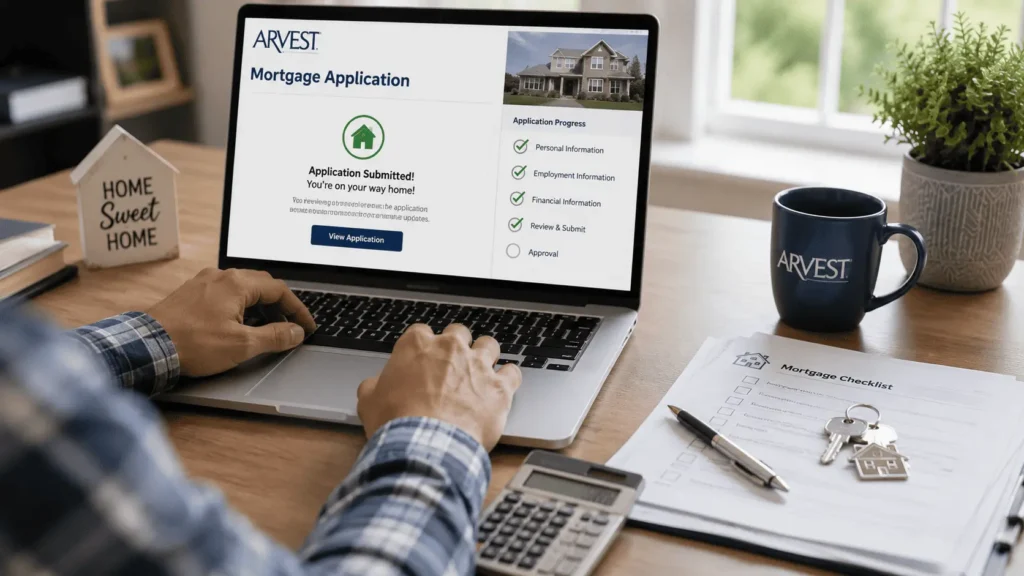
Arvest gives you three ways to start: online, through the Home4Me mobile app, or face-to-face with a local lender. The bank does not charge a separate fee for using its app. Pick whichever path feels most comfortable for you.
The smart first step is pre approval, which shows sellers you are a serious buyer. It also tells you exactly how much house you can afford before you fall in love with one. Here is the basic path for an arvest mortgage loan from start to finish:
- Get pre-qualified online, by app, or by phone
- Submit your full application with documents
- Lock your interest rate with your loan officer
- Complete the home appraisal and underwriting review
- Sign your closing papers and get your keys
Most buyers who want to apply for a home with bank support prefer this guided process over going it alone. The local officers walk you through each stage and answer questions in plain language.
Arvest Mortgage Fees and Closing Costs
Here is where you need to pay close attention. Arvest is clear about its rates but less public about its exact fees. Closing costs at most lenders run between 2% and 5% of the home price.
These costs usually include origination charges, appraisal fees, title work, and recording fees. Ask for a Loan Estimate as soon as you apply, since federal law requires the bank to give you one. Compare that estimate against other lenders before you commit. A small fee difference can mean thousands of dollars over the life of your mortgage.
Watch for these common charges on your Loan Estimate. The origination fee covers the cost of processing your file. The appraisal fee pays a licensed expert to value your home. Title fees protect you from ownership disputes down the road. Recording fees go to your local county office. None of these are unique to Arvest, but knowing them helps you spot anything unusual before signing.
Where Is Arvest Mortgage Available?
Arvest runs physical branches in four states: Arkansas, Kansas, Missouri, and Oklahoma. If you live in this region, you get the full in-person experience with local bank officers who know your market.
The lending footprint goes much wider, though. Arvest can lend in almost every state, with five exceptions: Delaware, Maryland, New Hampshire, New York, and Rhode Island. Buyers in those states will need to look elsewhere.
How to Make Your Arvest Mortgage Payment
Once your loan closes, paying each month is simple. The fastest way is the myMortgage online portal, where you can also view your payment history and update your details. Many borrowers set up auto draft so the payment never slips their mind.
Prefer other options? You have several payment methods to choose from:
- Automated phone system at (800) 366-2132
- A live customer care representative at the same number
- Bill pay through your own bank
- Mailing a check to P.O. Box 661005, Dallas, TX 75266-1005
For account questions, the bank also offers the Ask Arvest tool on its website. Email support requests can be sent through your servicing portal, or you can reach out to a mortgage specialist like james@allthings-mortgage.com for general guidance.
Refinancing With Arvest Mortgage
Already own a home? Refinancing with Arvest may lower your interest rate or shorten your loan term. Some homeowners refinance to drop mortgage insurance once they build enough equity.
The process looks much like a new purchase, with an application, appraisal, and closing. Keep in mind that refinance transactions may carry extra fees, and advertised purchase rates do not apply to them. Run the numbers first to make sure the monthly savings beat the upfront costs.
A good rule of thumb is the break-even test. Divide your total refinance costs by your monthly savings. If the answer is 24, you need to stay in your home at least 24 months to come out ahead. Homeowners planning to move soon often skip refinancing for this exact reason. Your loan officer can run this math with you for free.
Arvest Mortgage Reviews: What Customers Say
The customer feedback for Arvest is strong, especially for a regional bank. On Zillow, the company holds a near-perfect rating close to 4.99 out of 5 stars from well over a thousand reviews. Borrowers praise the friendly local service and smooth closings.
On ConsumerAffairs, the score sits lower at around 4.1 out of 5. Some complaints mention slow customer service on servicing issues, especially in tricky cases like accounts after a death in the family. If you need help fast, calling the Arvest mortgage phone number directly usually beats waiting on email replies.
Is Arvest Mortgage Right for You? Pros and Cons
No lender is perfect for everyone, so weigh both sides honestly. An arvest mortgage loan shines in some areas and falls short in others.
Pros:
- Services 99% of its own mortgages, so your account stays put
- Posts daily rates online, which most banks hide
- Wide product range, including construction and zero-down options
- Excellent customer ratings on Zillow
- Local branches with real human support in four states
Cons:
- Not available in five states
- Fee details are not published upfront
- Rates may not beat the cheapest online lenders
- Some servicing complaints on complex account issues
Choose Arvest if you value personal service, want your servicer to never change, or live in its branch region. Skip it if you live in an excluded state or only care about finding the rock-bottom rate online.
Conclusion
At the start, we promised to show you whether this lender deserves your trust, and now you have the full picture. An arvest mortgage loan offers solid product variety, transparent daily rates, and rare servicing stability that keeps your account in one place. The main drawbacks are limited state coverage and fees you must ask about directly. Compare your Loan Estimate with two or three other lenders, and you will walk into your closing with total confidence.
Frequently Asked Questions
What credit score do you need for an Arvest mortgage?
Most borrowers need a credit score of 620 or higher for a conventional Arvest mortgage. FHA and VA options accept lower scores. A stronger score earns better rates, so check your credit report before applying to fix any errors early.
Does Arvest sell your mortgage after closing?
No, Arvest services about 99% of the mortgages it creates. Your account stays with the same bank from closing until payoff. This means your payment portal, contact number, and servicing team never change, unlike many lenders that sell loans quickly.
How long does Arvest mortgage approval take?
Pre-qualification with Arvest takes just minutes online or through the Home4Me app. Full approval usually takes 30 to 45 days, covering underwriting, appraisal, and closing. Submitting complete documents early, like pay stubs and tax returns, speeds up the process.
Can you buy a house with no down payment at Arvest?
Yes, Arvest offers two zero-down options. VA loans serve veterans and active military members, while USDA loans cover buyers in approved rural areas. Both skip the large upfront payment, though USDA borrowers must meet income limits for their county.
Does Arvest charge a fee for early mortgage payoff?
Arvest does not advertise prepayment penalties on standard mortgages. You can pay extra toward your principal each month or pay off the balance early. Always confirm your exact loan terms at closing, since conditions can vary by product type.