

Saving for a down payment in Indiana feels like filling a bucket that keeps leaking. Rent goes up, groceries go up, and the pile you set aside never seems to catch the price of a house. Most buyers I talk to are not lazy savers — they are simply short by ten or fifteen thousand dollars, and nobody has told them the state will hand them a chunk of that money. The confusing part is that half the guides online still list programs Indiana shut down years ago.
This guide fixes that. Below you will find the four programs Indiana actually runs in 2026, the exact credit score and income rules, the repayment traps buried in the fine print, and the local grants that stack on top. Everything here comes straight from the Indiana Housing and Community Development Authority (IHCDA) program guide dated February 2026 and the current lender matrix. By the end, you will know which first time home buyer Indiana program fits you and what your first move should be.
Indiana housing snapshot (early 2026)
- Median home price: about $261,000 (Redfin)
- Typical down payment: roughly $25,000
- IHCDA down payment help available: 2.5% to 5% of the purchase price
- Reservation fee to lock a program: $250, non-refundable
What Is a First-Time Home Buyer Program?
A first-time home buyer program is government-backed help that lowers your upfront cost of buying a house. It usually comes as down payment assistance, a cheaper interest rate, or a mix of both.
These programs exist because the down payment, not the monthly payment, is what stops most renters. Someone can comfortably pay $1,400 a month in rent but still not have $15,000 sitting in a savings account. A first time home buyer Indiana program closes that gap so you can buy years earlier than you planned.
In Indiana, the state agency behind these programs is IHCDA. It does not lend money directly. It sets the rules, funds the assistance, and works through approved banks and credit unions across all 92 counties.
Who Qualifies as a First-Time Home Buyer in Indiana?
You qualify if you have not owned a home you lived in during the last three years. That is the short answer, and it surprises a lot of people who owned a house a decade ago.
The rule applies only to people signing the loan documents and living in the home. Other adults in the household do not count. Below are the details that decide most first time home buyer Indiana applications.
The 3-Year Rule Explained
IHCDA looks back exactly three years from your closing date. If you held an ownership interest in your main residence at any point in that window, you are out.
Ownership interest covers more than a normal deed. It includes:
- A fee simple deed in your name
- Joint tenancy or tenancy by the entirety
- A life estate
- A land contract, even if the title never transferred
- Property held in trust for you
- A factory-made home permanently attached to land and taxed as real estate
Things that do not count include a lease, a remainder interest, expecting to inherit a house someday, and owning a vacation home or rental you never lived in.
Exceptions — Veterans and Targeted Area Buyers
Two groups skip the three-year rule completely, and almost no other guide mentions this.
First, eligible veterans. If you served in the active military, naval, or air service, or in the Indiana National Guard, and did not receive a dishonorable discharge, the first-time requirement is waived. You verify it with a DD-214. People eligible for VA health benefits also qualify.
Second, buyers purchasing in a targeted area. If the home sits in a HUD-designated qualified census tract or an area of chronic economic distress, you can already own a home and still use the program. This single exception opens a first time home buyer Indiana program to thousands of repeat buyers who assume they are locked out.
Edge Cases: Mobile Homes, Divorce, Land Contracts, Inherited Property
These situations trip people up constantly, so here is how IHCDA treats each one.
Mobile homes. Owning a single-wide does not disqualify you, as long as the hitch and axles are still attached, it can legally travel a state highway without being split apart, and nothing permanent like a deck or room addition was added. Owning a double-wide in the last three years does disqualify you.
Divorce or separation. If you divorced or were displaced within the last three years and had an ownership interest, you can still qualify — but only if you lived somewhere else for the full three years before closing. Your divorce decree must show the property was non-marital, and you will need a lease or signed statement as proof.
Inherited property. Simply expecting to inherit a house means nothing. But if you moved into an inherited property after taking vested title, your first-time status ends.
Land contracts. A land contract counts as ownership even though legal title has not transferred. Many rent-to-own buyers do not realize this until an underwriter flags it.
Indiana First-Time Home Buyer Programs (IHCDA) — 2026
IHCDA runs exactly four homeownership programs in 2026. Three are for buying, and one is for refinancing an existing IHCDA loan.
This is where most competing articles go wrong. Several still list a 6% assistance program and a Mortgage Credit Certificate that IHCDA no longer offers to new buyers. Every number below comes from the current program guide.
All 4 IHCDA Programs at a Glance
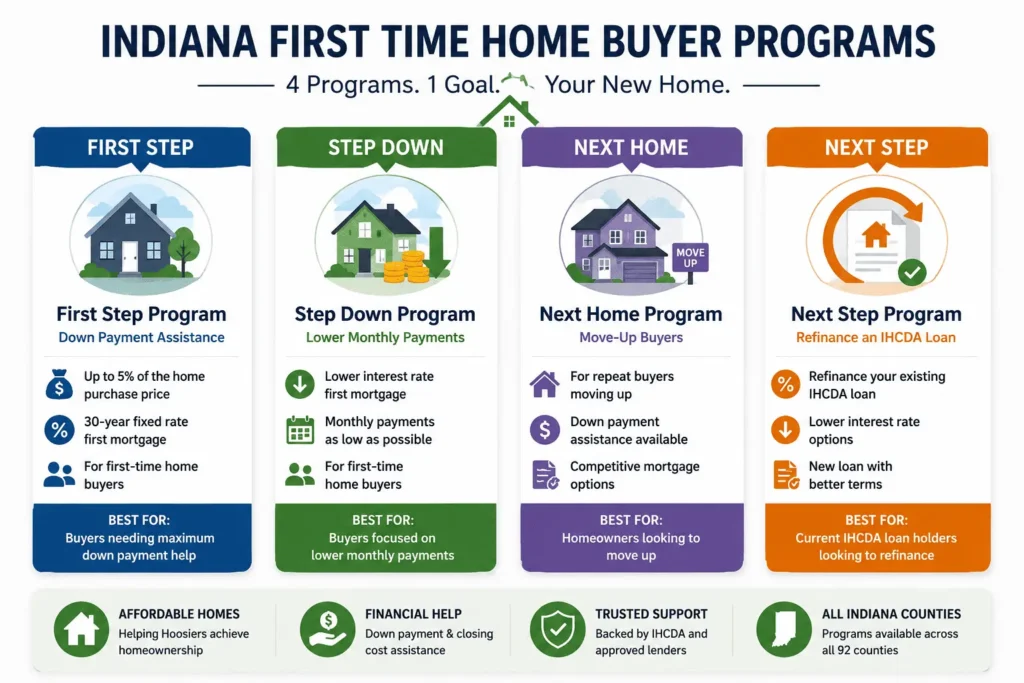
| Program | Down payment help | Forgivable? | First-time buyer required? | Min. credit score | Best for |
| First Step | 5% of purchase price | No | Yes (unless veteran or targeted area) | 660 (680 if DTI is 45-50%) | Buyers with little or no savings |
| Step Down | None – rate only | N/A | Yes (unless veteran or targeted area) | 660 (680 if DTI is 45-50%) | Buyers who have savings and want the lowest rate |
| Next Home | 2.5% or 3.5% | No | No | 660 (680 if DTI is 45-50%) | Repeat buyers and modest-savings buyers |
| Next Step | Matches existing lien | No | Existing IHCDA borrowers only | Set by servicer | Refinancing an IHCDA mortgage |
IHCDA First Step Program
First Step is the most generous option Indiana offers right now. It is funded by mortgage revenue bonds and pairs down payment assistance with a 30-year fixed mortgage.
How Much Down Payment Assistance You Get (5%)
First Step gives you five percent of the purchase price as down payment assistance. On a $261,000 home, that is roughly $13,050.
You will still see older articles claiming 6%. That figure came from a 2023 conventional program guide that IHCDA retired. The current lender matrix, effective 2025 and carried into the February 2026 guide, lists 5% flat across both FHA and conventional versions.
The money arrives as a second mortgage. You make no monthly payments on it, but it is not a gift.
Eligibility Requirements
To use First Step you must:
- Be a first-time buyer, an eligible veteran, or buying in a targeted census tract
- Buy a single-family home in Indiana and live in it as your main residence
- Stay under the county income limit and the county acquisition (purchase price) limit
- Keep the purchase price at or below the appraised value
- Hit a 660 credit score with a debt-to-income ratio of 45% or less
- Use a 30-year fixed FHA, Fannie Mae, or Freddie Mac loan
- Pay the $250 non-refundable reservation fee
One more rule worth knowing: no manual underwriting is allowed on First Step. Your file has to pass an automated underwriting system.
Pros and Cons
Pros
- Largest assistance amount in the state
- No monthly payment on the second mortgage
- Works with FHA or conventional financing
- Over 50 participating lenders statewide
Cons
- Fully repayable when you sell, refinance, or move out
- Cannot be combined with any other IHCDA program
- Subject to federal recapture tax in the first nine years
- $250 fee is lost if your loan falls through
IHCDA Step Down Program
Step Down is the quietest of the Indiana first-time home buyer programs, and it is also the most misunderstood.
Why Step Down Has No Down Payment Assistance
Step Down gives you a discounted interest rate and nothing else. There is no second mortgage, no cash toward your down payment, and no assistance lien on your title.
Two major finance sites describe Step Down as an “interest-only mortgage.” That is incorrect. IHCDA’s own lender matrix labels it “interest rate only,” meaning the benefit is the rate itself. The loan is a standard 30-year fixed mortgage where you pay principal and interest from month one.
Because you skip the assistance lien, you also skip the repayment headache later. If you already have savings and just want a better rate, this is often the smarter pick — and it pays to compare what other lenders are quoting before you lock.
Eligibility Requirements
The rules mirror First Step almost exactly:
- First-time buyer, eligible veteran, or targeted area purchase
- Indiana primary residence only
- County income and acquisition limits apply
- 660 minimum credit score, 680 if your DTI runs 45-50%
- 30-year fixed FHA or conventional financing
- $250 reservation fee
- No manual underwriting
Pros and Cons
Pros
- Below-market interest rate for the full 30 years
- No second mortgage to repay later
- No lien complications if you refinance
- Simpler closing paperwork
Cons
- Zero help with your down payment
- Still triggers federal recapture tax rules
- Cannot be paired with another IHCDA program
- You need your own cash to close
IHCDA Next Home Program
Next Home is the only IHCDA purchase program open to repeat buyers. It runs on TBA funding instead of bond funding, which changes a few rules.
2.5% vs 3.5% — Which One You Qualify For
Next Home offers either 2.5% or 3.5% in down payment assistance. Your lender determines which tier applies based on the loan product and pricing at the time you reserve.
The percentage is calculated on the purchase price or the appraised value, whichever is lower. That detail matters. If a home appraises below the contract price, your assistance shrinks with it.
Unlike the bond programs, Next Home also allows property eligibility exception reviews case by case. That flexibility helps buyers with unusual lots or property types.
Eligibility Requirements
- Open to first-time and repeat buyers
- Indiana primary residence
- County income limits apply
- 660 credit score at 45% DTI, 680 at 45-50% DTI
- 660 minimum for manufactured housing
- 30-year fixed FHA or conventional loan
- $250 reservation fee
Pros and Cons
Pros
- No first-time buyer requirement at all
- Smaller lien means less to repay later
- Property exception reviews available
- Same lender network as the bond programs
Cons
- Assistance is smaller than First Step
- Still non-forgivable
- Tied to the lower of price or appraised value
- Cannot stack with another IHCDA product
IHCDA Next Step Program (Refinance)
Next Step is the program almost nobody writes about, and it only matters after you already own.
It gives existing IHCDA borrowers a one-time chance to refinance their first mortgage. You qualify if you currently hold a First Place, First Step, or Step Down mortgage serviced through IHCDA. The new loan is a 30-year fixed FHA or conventional mortgage at an affordable rate.
Here is the part that saves people money. Normally, refinancing forces your assistance second mortgage to be repaid in full immediately. Refinancing through Next Step avoids that. If you hold a First Place or Step Down mortgage, you can even apply for a new assistance lien matching your current IHCDA lien amount.
If you are weighing whether the numbers work, run them the same way you would for any other refinance decision — closing costs, break-even point, and how long you plan to stay.
What Happened to the First Place Program?
First Place ended on December 31, 2023. It is gone, and no new buyer can apply for it.
You will still find bank and credit union pages published in 2026 promoting First Place with “6% forgivable assistance.” Both parts of that claim are outdated, and the forgivable part was never accurate for IHCDA’s structure anyway.
First Place still shows up in two places. Its program guides sit in IHCDA’s archive section, and existing First Place borrowers remain eligible for the Next Step refinance. If a loan officer offers you First Place today, that is a strong sign they have not checked IHCDA’s guidelines recently.
Questions about which program a specific lender actually offers can go to james@allthings-mortgage.com.
How IHCDA Down Payment Assistance Actually Works
Understanding the assistance lien is more important than picking the program. This is where buyers get blindsided three or four years down the road.
Non-Forgivable Means You Pay It Back — Here’s When
IHCDA down payment assistance is a loan, not a grant. It is secured by a second mortgage with IHCDA holding title as evidence.
The full balance becomes due when any of these happen:
- You sell the home
- You refinance outside an IHCDA refinance program
- The home stops being your primary residence
- Foreclosure proceedings begin
- You break any term in the second note
There is no proration. Living in the home for eight of thirty years does not reduce what you owe. You repay 100% of the original assistance amount. When that day comes, you will need to request a payoff statement covering both the first and second mortgage.
The HELOC Trap Most Buyers Miss
Taking out a home equity line of credit triggers full repayment of your assistance lien.
This is written plainly in the IHCDA program guide, and it appears in exactly zero competitor articles. A buyer who uses First Step, builds equity for six years, then opens a HELOC to remodel a kitchen can suddenly owe $13,000 back to IHCDA.
IHCDA will also not subordinate its second mortgage to any new claim, except an original first mortgage or an IHCDA-approved refinance. So the HELOC lender cannot simply move ahead in line. Before you touch your equity, call your servicer and confirm what your second lien requires.
What You Can Spend DPA On (Including Realtor Fees)
Down payment assistance is not limited to the down payment. IHCDA allows it to cover:
- The down payment itself
- Closing costs
- Prepaid items like taxes and insurance escrow
- Realtor compensation
That last item became a big deal after buyer-agent commissions moved onto the buyer’s side of the table. Being able to fund your agent’s fee from assistance money is a real advantage, and almost no guide mentions it.
One limit applies: if you use assistance funds, you cannot receive cash back at closing, except for documented money you personally invested.
Can You Combine IHCDA With Other Assistance Programs?
Yes — with outside programs. No — with a second IHCDA program.
You can only hold one IHCDA mortgage at a time, and the programs cannot be layered on each other. But IHCDA does allow layering with non-IHCDA grants and assistance if four conditions are met:
- The file meets that outside program’s own guidelines
- The U.S. Bank first mortgage stays in first lien position
- The IHCDA assistance stays in second lien position
- Any additional funding takes third lien position
That means a Marion County buyer can pair First Step with city assistance from INHP, as long as the lien order works. Stacking is how buyers get to a genuinely zero-cash closing.
IHCDA Credit Score, DTI, and Income Requirements
These three numbers decide whether your file moves forward. They are also where outdated articles cause the most damage.
Minimum Credit Score (660 / 680)
You need a 660 credit score with a debt-to-income ratio of 45% or lower. If your DTI lands between 45% and 50%, the minimum rises to 680.
Manufactured housing carries its own floor of 660 regardless of program. These thresholds come from the IHCDA lender matrix and apply across First Step, Step Down, and Next Home, on both FHA and conventional loans.
Popular finance sites still publish 640 for these programs. That number is roughly two years stale, and a buyer relying on it can waste a $250 reservation fee finding out.
Income Limits — Whose Income Actually Counts
IHCDA counts the qualifying income of the borrowers on the loan application only — not the whole household.
This is a genuine advantage over many state programs. An adult sibling or roommate living with you does not push you over the limit. Non-occupant co-signers are allowed, and IHCDA excludes their income entirely.
Qualifying income is broad, though. It includes wages, overtime, tips, bonuses, commissions, self-employment income, child support, alimony, Social Security and SSDI, pensions, interest and dividends, unemployment, rental income, and regular gifts from someone outside the home. Limits vary by county and family size.
County Purchase Price (Acquisition) Limits
The home’s acquisition cost must stay under your county’s limit. IHCDA publishes separate limit sheets for First Step, Step Down, and Next Home FHA versus the conventional products.
Acquisition cost is not just the sticker price. It also includes the reasonable cost of finishing an incomplete home, unusual settlement costs like rate buydown points, unprorated property taxes you agree to pay, and the value of land you have owned less than two years.
It excludes normal closing costs — title insurance, survey fees, appraisal, legal fees, and inspections. Sweat equity you or your family provide does not count either.
Required Homebuyer Education — HomeView and CreditSmart Only
Homebuyer education is required for every occupying applicant on conventional assistance products. Here is the part lenders forget to mention.
IHCDA accepts only two courses: Fannie Mae’s HomeView and Freddie Mac’s CreditSmart. The program guide states plainly that no substitutes are accepted. A HUD-approved local course, however good, will not clear the condition.
Your certificate must be uploaded during the initial application, not at closing. Finishing the course before you shop saves real time.
Indiana Targeted Areas — Where First-Time Buyer Rules Don’t Apply
Targeted areas are the biggest loophole in the entire system. Buy inside one, and the three-year ownership rule disappears.
The 30 Targeted Counties
IHCDA designates 30 Indiana counties as targeted areas in full:
Brown, Clinton, Crawford, Daviess, Dearborn, Decatur, Fayette, Franklin, Fulton, Greene, Jackson, Jasper, Jefferson, Knox, Lawrence, Miami, Ohio, Orange, Owen, Parke, Perry, Pike, Rush, Scott, Shelby, Spencer, Vermillion, Vigo, Washington, and Wayne.
If your home sits in any of these counties, you can use a first time home buyer Indiana program even if you already own or recently sold a house. You still have to meet income, credit, and purchase price rules — only the ownership history requirement is waived.
Targeted Census Tracts in Non-Targeted Counties
Targeted status also exists at the census tract level inside counties that are not targeted overall.
A qualified census tract is one where 70% or more of families earn 80% or less of the statewide median family income. Areas of chronic economic distress, designated by the state and approved federally, also count.
There is a paperwork step here. Your appraiser must note the qualifying census tract on the appraisal itself. Without that notation, IHCDA cannot apply the exemption, no matter what a map says.
The Federal Recapture Tax on IHCDA Loans
Recapture tax is the least understood part of Indiana first-time home buyer programs. It applies to bond-funded loans, which means First Step and Step Down.
Congress created it in 1988 to claw back part of the subsidy if a buyer sells early and profits. It is owed to the IRS, not to IHCDA.
The Three Conditions That Trigger It
You owe recapture tax only if all three of these are true at once:
- The home stops being your principal residence within the first nine full years after closing
- You make a profit on the sale
- Your household income that year exceeds the adjusted qualifying income for your family size
Miss any one of the three and you owe nothing. Most sellers fail at least one condition, which is why actual recapture bills are rare.
How Much You Could Owe
Your maximum exposure is the lesser of 6.25% of your original loan amount, or 50% of your gain on the sale.
The actual amount is usually far smaller, because it also multiplies by a holding period percentage that rises then falls:
- Months 1-12: 20%
- Months 13-24: 40%
- Months 25-36: 60%
- Months 37-48: 80%
- Months 49-60: 100%
- Months 61-72: 80%
- Months 73-84: 60%
- Months 85-96: 40%
- Months 97-108: 20%
- Month 109 and later: no recapture tax
An income percentage applies on top. If your income exceeds the limit by $5,000 or more, that percentage is 100%. If it exceeds by less, you divide the excess by $5,000.
IHCDA mails you a Notice of Maximum Recapture Tax within 90 days of final approval. Keep it — you will need it if you sell. If you owe, you file IRS Form 8828 for the year of the sale.
When You’re Exempt
No recapture tax is due if:
- You sell more than nine years after closing
- The home is disposed of because of your death
- You transfer it to a spouse or former spouse in a divorce with no gain reported
- You sell at a loss
- You refinance (unless you later meet the recapture rules anyway)
- Fire, storm, flood, or another casualty destroys the home and you rebuild on the same site within two years
Property Requirements for Indiana First-Time Buyer Programs
The house has to qualify, not just you. These rules end more deals than credit scores do.
Eligible Property Types
IHCDA finances five property types:
- Single-family detached homes
- Townhomes
- Planned unit developments (PUDs)
- Condominium units, which need U.S. Bank, FHA, Fannie Mae, or Freddie Mac approval
- Manufactured homes that are HUD-plated, double-wide, and permanently affixed
Investment properties, rentals, and vacation homes are excluded. So is any home where more than 10% of the space is used regularly for a business, holds trade inventory, or serves as your principal place of business.
Your lender will also require homeowners insurance naming the servicer correctly. Getting the mortgagee clause right on that policy prevents a very common closing delay.
The 1-Acre and 1-Parcel Rule
Federal rules stop IHCDA from financing land beyond what maintains “basic livability.” Indiana interprets that as one acre and one parcel.
Go over an acre and you will need a zoning ordinance or an appraiser’s written comment justifying the extra land. Exceptions exist with supporting documentation, but they are not automatic.
IHCDA also cannot finance buildable land, land that could produce income, or extra parcels not needed for the home. If a property has additional structures or living quarters, expect an Auxiliary Unit Affidavit.
Occupancy Requirements
You must move in within 60 days of closing and keep the home owner-occupied for the life of the loan.
Only applicants listed on the loan application may sign IHCDA documents and take title. A spouse who is not on the application cannot be added to the deed at closing. Co-signers are allowed, but they cannot take title either.
That last rule matters if you are buying alongside family. Arrangements like a family opportunity mortgage for a parent or disabled child follow different rules and generally will not fit inside an IHCDA program.
City and County Home Buyer Assistance in Indiana
Local programs stack on top of IHCDA money. This is where buyers reach zero out-of-pocket.
Indianapolis — INHP Down Payment Assistance
The Indianapolis Neighborhood Housing Partnership offers between $7,500 and $24,999 in down payment help, scaled to household size and income.
The catch is that you must get your mortgage through INHP itself to qualify. For Marion County buyers, the upper end of that range is the largest single assistance amount available anywhere in the state.
Bloomington HAND Down Payment Assistance
Bloomington’s Housing and Neighborhood Development office provides up to $10,000 to first-time buyers earning 80% or less of area median income.
It comes as a second mortgage forgiven after five years. You must finish a homebuyer education class and use a lender willing to accept a HAND second mortgage — not every lender will.
Evansville HOPE Down Payment Assistance
HOPE of Evansville matches up to $15,000 in down payment funds for first-time buyers inside city limits.
You contribute at least $1,000 of your own money and meet income and purchase price caps. It is forgivable if you stay in the home long enough. Budget for the $80 education course fee and an $875 contingency addendum fee.
Fort Wayne, South Bend, and Gary Programs
Indiana’s other mid-size cities run their own assistance through community development departments and nonprofit partners, funded largely by federal HOME dollars.
Amounts, income caps, and forgiveness terms change year to year as funding cycles reset. Contact your city’s community development office directly, since these rarely appear in national roundups. Lake County buyers should also ask about county-level HOME assistance separate from Gary’s city program.
FHLBI Homeownership Grants
The Federal Home Loan Bank of Indianapolis funds grants through its member banks and credit unions.
You can tell these exist because IHCDA publishes a separate income and acquisition limit sheet just for FHLBI members. These grants are true grants in many cases, not repayable liens, which makes them worth asking about specifically.
Only member institutions can offer them, so ask any lender you interview whether they are an FHLBI member.
IHCDA Individual Development Accounts (Matched Savings)
IDAs are matched savings accounts run by IHCDA through community partners. You save toward a home purchase and the program multiplies your deposits.
Because you build the match over time, IDAs work best if you are twelve to twenty-four months away from buying. They pair well with assistance programs later, since the saved funds count as your own contribution.
Federal Loan Programs Indiana Buyers Can Use
IHCDA assistance rides on top of a federal or conventional first mortgage. Here is what each offers.
FHA Loans
FHA loans are insured by the Federal Housing Administration and accept credit scores as low as 580 with 3.5% down. They are the most common pairing with Indiana assistance.
The tradeoff is mortgage insurance premiums, which you pay upfront and monthly. Understanding how mortgage insurance affects your payment before you commit prevents budget surprises later.
VA Loans
VA loans serve active-duty members, veterans, and eligible surviving spouses. They typically require no down payment and carry no monthly mortgage insurance.
You will need a Certificate of Eligibility. The VA sets no minimum credit score, though most lenders want low 600s. Remember that veteran status also waives the IHCDA first-time buyer rule.
USDA Loans
USDA loans offer 100% financing for homes in eligible rural and suburban areas. Much of Indiana outside the major metros qualifies.
Household income limits apply and are set by area. Since USDA covers the down payment already, buyers often pair it with a rate-focused strategy rather than assistance.
HomeReady and Home Possible
HomeReady comes from Fannie Mae and Home Possible from Freddie Mac. Both need just 3% down and use flexible income rules, including income from household members not on the loan.
Both are conventional loans, so they work with IHCDA assistance on the conventional side. They also allow mortgage insurance to be canceled once you reach 20% equity, unlike FHA.
Which Indiana Program Is Right for You?
Matching yourself to the right product takes two minutes if you know your situation.
If You Have No Savings for a Down Payment
Go with First Step. Five percent is the most money the state will put on the table, and it covers closing costs and prepaids too.
Layer a local program on top if your city offers one. Run your numbers through a monthly payment calculator first so the payment fits your budget, not just the closing.
If You Want the Lowest Interest Rate
Choose Step Down. You give up the assistance, but you gain a discounted rate for three decades and a clean title with no second lien.
Over a full loan term, the rate savings can exceed the 5% you would have received. This is the better math if you already have your down payment saved.
If You’ve Owned a Home Before
Next Home is your only IHCDA purchase option. It carries no first-time requirement at all.
Alternatively, check whether your target county appears on the targeted list above. If it does, First Step and Step Down reopen to you at their full benefit levels.
If You’re a Veteran
Every IHCDA program is available to you regardless of ownership history. Compare a VA loan on its own against a First Step assistance package with FHA financing.
A VA loan already requires zero down, so assistance money would go toward closing costs instead. Ask a lender to price both side by side.
How to Apply for Indiana First-Time Home Buyer Assistance

The application runs through your lender, not through IHCDA directly. Here is the order of operations.
Step 1: Check Income and Purchase Price Limits
Pull the current limit sheet for your county and family size from the IHCDA website before you do anything else.
There are separate sheets for FHA products and conventional products, and they update periodically. If you sit close to a limit, ask your lender to calculate qualifying income precisely rather than estimating.
Step 2: Complete Homebuyer Education
Finish Fannie Mae HomeView or Freddie Mac CreditSmart online. Both are free and take a few hours.
Save the certificate as a PDF. It has to be uploaded with your initial application package, so having it ready keeps your file moving.
Step 3: Find an IHCDA Participating Lender
Only approved lenders can originate these loans. IHCDA publishes a participating lenders list with more than 50 institutions.
Interview two or three. Ask which IHCDA products they actively originate, whether they are an FHLBI member, and what their lender fees run. Knowing what to look for when comparing home loans helps you spot the difference between a good rate and a good deal.
Step 4: Reserve Your Loan (and Pay the $250 Fee)
You need a signed purchase agreement before your lender can reserve funds. Reservations happen Monday through Friday until 5:00 p.m. Eastern.
Your lender locks the rate in IHCDA’s DMS Online system. The $250 fee is non-refundable and rate buydowns are not permitted. Once locked, you cannot re-lock a new application for 60 days.
Step 5: Close Within the 60-Day Window
Your commitment expires 60 days after reservation. The loan must be sold to the master servicer and purchased by IHCDA before that date.
Extensions exist but cost 0.0125% per 15 days. After closing, your lender delivers the file to U.S. Bank within 30 days, and servicing transfers from there. Loans change hands more than most buyers expect — understanding what happens when a servicer takes over saves confusion later.
What It Actually Costs to Apply
Bond-funded IHCDA loans cap what a lender can charge you, which is a protection most buyers never hear about.
- Origination fee: maximum 1% of the loan
- Total lender fees: maximum $1,600
- Reservation fee: $250, non-refundable
- Lock extension: 0.0125% per 15 days
- Program or loan type change after closing: $500 charged to the lender
If a quote exceeds these caps on a bond product, question it. Anything unclear on your fee sheet is worth a second opinion at james@allthings-mortgage.com.
Common Mistakes That Disqualify Indiana First-Time Buyers
Most denials come from avoidable errors, not weak finances.
- Taking the wrong education course. Only HomeView and CreditSmart clear the condition. A local HUD course does not.
- Buying more than one acre. Anything over one acre or one parcel needs extra documentation, and many contracts die here.
- Adding a spouse to the deed at closing. Only loan applicants can take title. This gets caught at the closing table.
- Assuming a mobile home does not count. A double-wide owned in the last three years ends your first-time status.
- Letting income change mid-process. A raise or new job between reservation and closing forces recalculation, and you may exceed the limit.
- Trying to combine two IHCDA programs. You can only hold one at a time. Layer outside programs instead.
- Planning to rent out part of the home. Business or rental use above 10% disqualifies the property.
Conclusion
At the start, I promised you the four programs Indiana actually runs in 2026, the real numbers behind them, and the fine print other guides skip — and that is exactly what you now have. You know First Step pays 5%, Step Down trades assistance for a lower rate, Next Home welcomes repeat buyers, and Next Step protects your lien when you refinance. You also know the traps: the HELOC clause, the nine-year recapture window, the one-acre limit, and the two education courses that are the only ones accepted. Take your county limit sheet and your certificate to an approved lender this week, and your first time home buyer Indiana application can be reserved before the next rate sheet posts.
Frequently Asked Questions
Can I apply before I find a house?
No. IHCDA requires a valid, signed real estate purchase contract before your lender can reserve funds. You can complete homebuyer education and get pre-qualified first, but the reservation and the $250 fee come only after an accepted offer.
What happens if my income rises before closing?
Your lender must recalculate qualifying income before closing. If a raise, bonus, or new job pushes you above your county limit, the file no longer complies and the reservation fails. Report income changes to your loan officer immediately rather than at closing.
Can a non-occupant co-signer help me qualify?
Yes. IHCDA allows co-signers and non-occupant co-borrowers under agency guidelines. Their income is excluded from your qualifying income calculation, which can help. However, co-signers cannot sign IHCDA documents or take title to the property at closing.
What credit score do I need for a manufactured home?
A minimum 660 FICO score applies to manufactured housing across IHCDA programs. The home must be HUD-plated, double-wide, and permanently affixed to the land. It also needs approval from U.S. Bank, FHA, Fannie Mae, or Freddie Mac.
Who services my IHCDA loan after closing?
U.S. Bank HFA Division acts as master servicer for IHCDA’s homeownership department. Your original lender services both mortgages until U.S. Bank purchases them. Loans can transfer again later, so keep records of who currently services your mortgage.